
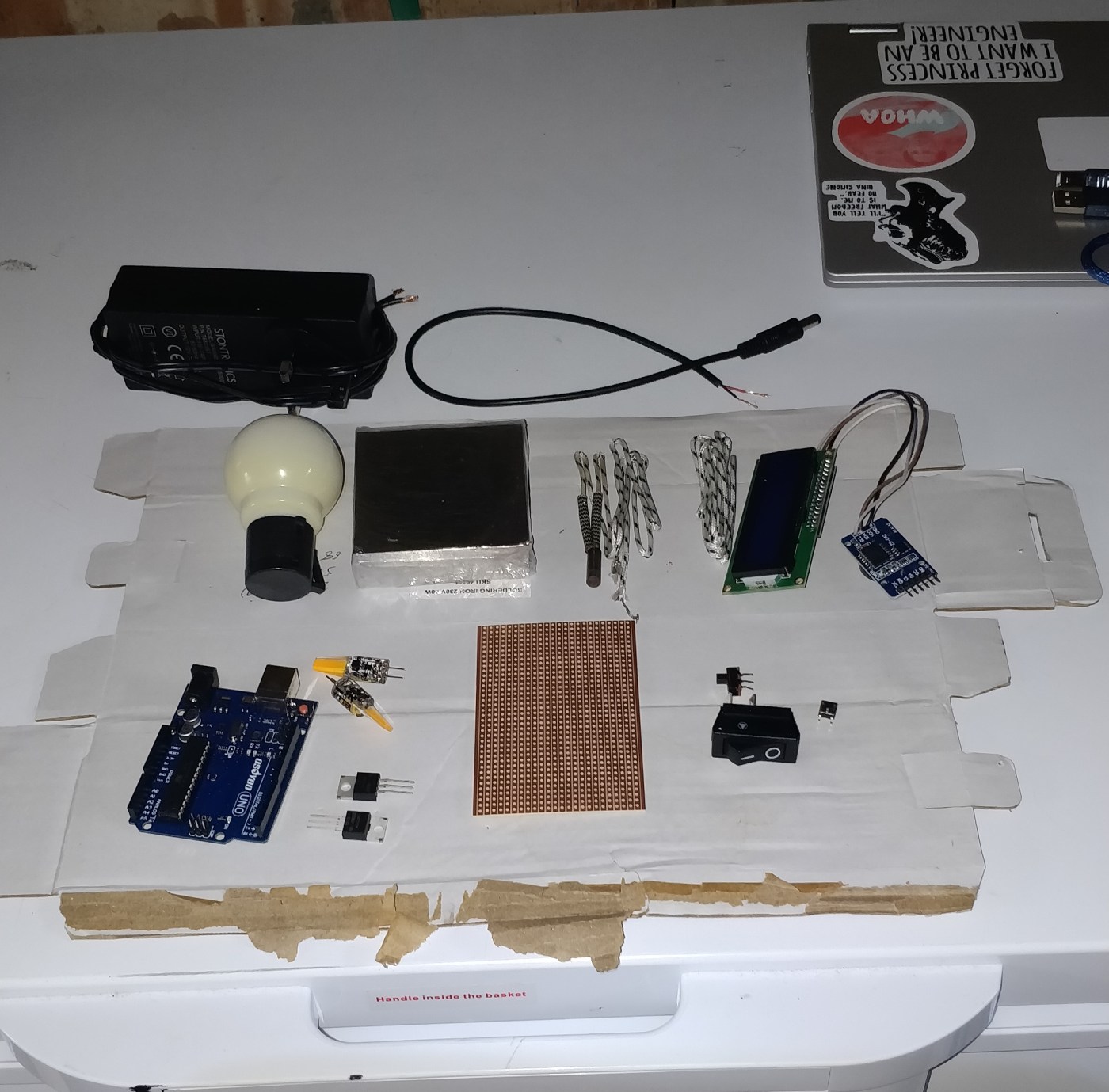
TL;DR: I’m documenting making an “Arduino” Uno alarm clock with LED sunrise and tea making features, hopefully in an entertaining way. Yes, I know no-one will have the patience to get through the writings of a man who makes a TL;DR this long. Maybe it’s a defence mechanism, seeing a block of text like this in the TL;DR section will drive people away so they never read and criticise my work. Maybe I’m just that vain that I think even people who have better things to do and just want to check out a quick summary would be better off spending time here because I’m just such a good writer. Maybe I’m just trying to make something I’ll be proud of and give my as yet latent inner writer an arena to create an Honest Expression.

This blog post, and entire website really, serves to document the tale of calamity and consternation that is the making of my alarm clock. For now this will just be a placeholder so I can find my bearings and make sure I’ve made the right call by using WordPress. In future this will be followed, either appended here (if that’s even possible) or in subsequent blog posts by the aforementioned documenting of one misery-averse man’s quest to introduce tea to his tragically Mrs. Doyle-less morning routine.
The general concept is to have an alarm clock which begins gradually illuminating the room half an hour before get-out-of-bed-and-push-that-boulder-up-the-hill o’clock, mimicking everyone’s favourite star that isn’t called Adele. As if recreating one of the most beautiful natural phenomena conceivable isn’t enough of a task, the alarm clock should also have some water prepared as if it were for chocolate at the Sisyphusean hour every morning. Throw a tea bag in and I can start everyday with a sunrise and a cup of tea.
An “Arduino” Uno is the brains, controlling dimmable LEDs of cooker hood eminence and a cartridge heater as found in 3D printers as well as communicating with a real-time clock and LCD screen.
As for the blog, it seems a little weird to me to be writing this way, flip-flopping between tones of reflection, commentary and planning but a typically concise style of run-down such as a report would ruthlessly highlight the irrelevance of the majority of what I want to write about. I want to write about all the mishaps and “side-quests” along the way and I know for me, as a reader, any other way of writing leads to me getting a little irritated by the more trivial anecdotes in a meandering story. If stories are written entirely in the past tense I find myself thinking “well the ending has already happened and I’d wager that this part had no bearing on it, the writer obviously knows this so why are we here?”. This feeling is exponentially greater when there’s an irrelevant aside in a report or an article. It’s very difficult to make insignificant side-stories so engaging that I forget they’re a part of a larger story with a pre-determined ending, while every “ed” suffixed verb chips away at this illusion. I do know how to enjoy a book, I don’t always treat each scene as means to an end but there are moments even in the best books where I find myself getting tired and searching for the main narrative. These books can be about time travel or life and death and be penned by writers I adore – I’m writing creatively for the first time and it’s about building a clock.
As is obvious from what I’ve said, the old adage “couldn’t see the forest for the trees” rarely applies to me, I’m often focused squarely on the forest. Why focus on one tree when you can look at them all as a forest and form an aggregate view – surely this is better to understand trees (says the engineer). To craft a tree with textures so nuanced and colours so brilliant that it overrides my internal default of wanting to use it to characterise all trees and instead makes me want to understand it alone and how it grew to be so enchanting, that’s a tall order. Thus, shifting through tenses to give the illusion of a currently developing story is best for me – as far as the reader knows there is no forest, only the individual trees they have been introduced to. The fact that the ink of the final words is just as dry regardless of the prose they employ is oddly inconsequential. That’s how I honestly feel and so that’s why this will be written as it is, because it’s for me, really, so I can try my hand at writing something I might enjoy reading.
My use of punctuation makes sense to me but I’ve never fully learned where commas are necessary or the best places for hyphens, semi-colons and full colons, so apologies if it irks you. As an absolute final aside, purely for my own reference – the URL for this blog post’s editing page is my new site’s address followed by /42. A coincidence obviously, but a profound one.
 Trysworth Curiosity Company
Leave a comment