Do You Have Ppe for Drilling Steel?

Story so far: The light circuit is working, so I can simulate a sunrise. The tea-making aspect remains to be seen to.

TL;DR: I drilled into a steel block and put a cartridge heater inside, the block is now a hot plate.

Following from the flaming failure of a first foray into hot plate building, a complete rethink was thunk. Now, I shall simply drill a hole into a steel block and insert the cartridge heater. The heater can do its thing until Tha Block is Hot and then the block can heat a cup of tea for breakfast. Seems reasonable?

The first step is to drill a cartridge heater sized hole in a steel block, that is, drill a cylinder of about 0.5cm diameter and 2.5cm depth. For reference, imagine a standard antibiotic pill in your hand, you know, half red, half yellow capsule full of feel-good, perfectly reasonable to be swallowed whole, as per its design. Now imagine the obtrusively sized, obtusely designed choking hazard that it morphs into the moment it leaves your sight and enters your mouth; that’s about the size of the cartridge heater.

A steel block and small heating element
The drilled hole and the heater, both lined with thermal paste.

Drilling a hole that size into steel with a hand drill is no routine procedure. Learning the correct method required substantial trawling through the unchartered waters of random forums and subreddits, where each comment further verifies the Big Fish Theory; expert metal workers are exposed as mere novices by increasingly snide remarks of “Um, actually…” that are as lacking in self-awareness as they are in relent – at least until someone mentions Hitler. Unsurprisingly, the omnipresent Mariana Trench of knowledge, YouTube, was also explored. One of the titans of the platform, Gus Johnson, was there to provide his trademark well-founded, rational and at times even cheekily comical interpretation, just as he has done for the trials and tribulations of the working man in America; the toxic lack of empathy that infects the landscape of Google reviews; and the decaying state of our natural world as we stray further from God. The video I speak of, though, is of course “Gus Johnson Sings an Entire Conway Twitty Album”.
Bus croons:

You want a man with a slow hand
. . .
You want somebody who will spend some time,
Not come and go in a heated rush

This pretty much sums it up. If you use a very high speed, you’ll initially drill through by scraping lots of very fine steel filings away, however, eventually you’ll end up with a thick, impenetrable layer of these filings at the bottom of your hole and all you can do is move them around and get them into a heated rush – blunting your drill bit in the process. What you want to do is keep the rpm low and apply as much pressure as you can downward through the drill bit. You’ll know you’re Doin’ it Right when the steel you’re cutting away starts to slither up the thread of your drill bit as continuous and spiralised serpentine articulations – acquiesced entirely to their charmer.

It really does require you to spend some time with it, baby. The hole I drilled took around 2 hours and it wasn’t light labour either! At first, I tried summoning every ounce of force I could muster from my arms and pushing down on the drill, whose response was to summon the spirit of Laura Les and subject me to the harshly shrill, yet somehow enchanting dissonance of the bit turning in place fruitlessly – thus reminding me that my arms are indeed like very roast-able little cigarettes. Ultimately the only way I could pile enough force behind the cutting edge of the drill bit to make it carve through the steel was to lie myself atop the heel of the drill and push my weight through it. While this was effective, every force has an equal and opposite reaction, and here I am pushing down through my sternum with enough force to continuously carve steel. You’d think with a name like sternum it’d be made of sterner stuff but turns out this process got pretty painful pretty pronto. So, if you ever want to attempt something similar make sure and check the checklist below.

PPE For Drilling Steel:

  • Goggles (Fine particles and smoke from burnt lubricating oil are both pretty bad for your eyes.)
  • Gloves (Brushing away metal swarf with bare hands is pretty much the exact same as rubbing a cheese grater.)
  • Chest Cushion (Place between sternum of driller and heel of drill to avoid bruising your chest the way you did after watching Tarzan for the first time.)
Some drilling equipment
The required PPE, plus a good example of the fine swarf you want to avoid creating. You can’t avoid it entirely. Bonus: Always have a hammer on hand.

Of course, all that list protects is your body and the many emasculating mistakes made along the way raise the question: Do You Have Ppe for Self-Esteem? Well, personally, I vacillate between immersing myself in music where I can imagine myself as the audacious and brazenly immodest protagonist and lamenting over music where I can think, “well, at least I’m not that guy”. Each the type of music that concerns itself so singularly with one pole of the human experience, disregarding disaffirmations so indiscriminately, that to tell someone you enjoy it is to sully their notion of you with an apprehensive perplexity regarding the lucidity of your perception.
Music to count marbles to for those who don’t get it, music to hide marbles to for those that do.

Anyway, that’s the heating block done, in a very uneventful series of events I coated the heater in thermal paste and shoved it into the hole then turned it on. The block got very hot and all seems good. Onwards.
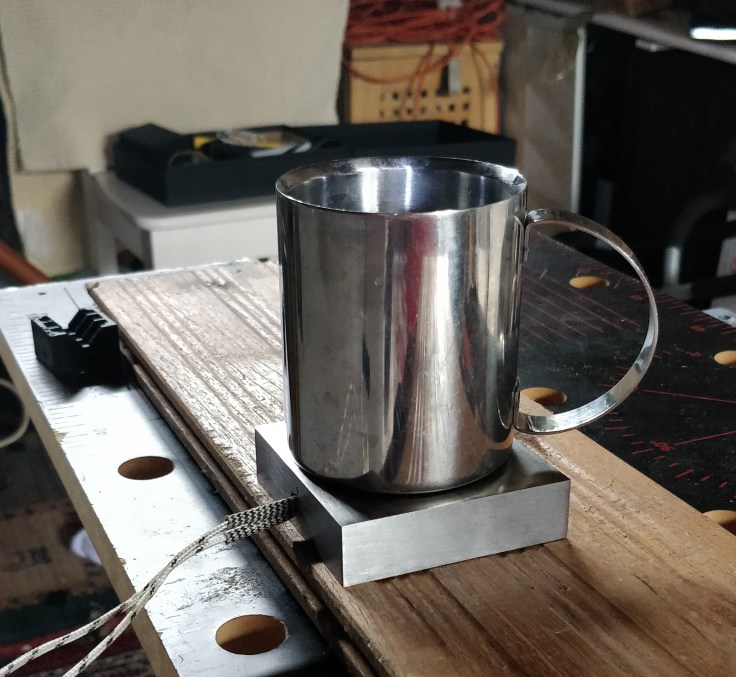
A cup on top of a steel block
The “finished” product. If you’re thinking “wait that block is far too big for efficient heat transfer!”, you’re right. I’ll address it when I’m good and ready to face up to my mistake.

Mouth Function Malfunction

Story so Far: Alarm clock build parts arrived, currently experimenting to get the heater part working in order to prepare a cup of tea. A cartridge heater being used to heat copper tubing which is spiralled into a hot plate is the current technology.

TL;DR: I tried using the copper spiral as a hot plate with wood around it to insulate. The wood caught fire. I tried without the wood, the heater got aggressively red hot. I conclude that I want more thermal mass – ordered a block of steel into which the heater can be inserted.

Test number 2 of the prospective heater set up was a resounding failure. I had the heater inserted into its cradle and a metal cup of water placed on the copper spiral of a ‘hot plate’. Before testing though I figured the near-constant draught in the garage might become a problem. My thinking was that while heat should find it easiest to move from the copper into the base of the metal cup and heat the water, a constant flow of cool air around the heating set up will absorb a significant amount of that heat. To limit this, I surrounded the heater in wood; now the heat had two options for where to go: a metal cup or a wooden block; in my head this was a no-brainer . . . my head is a no-brainer.


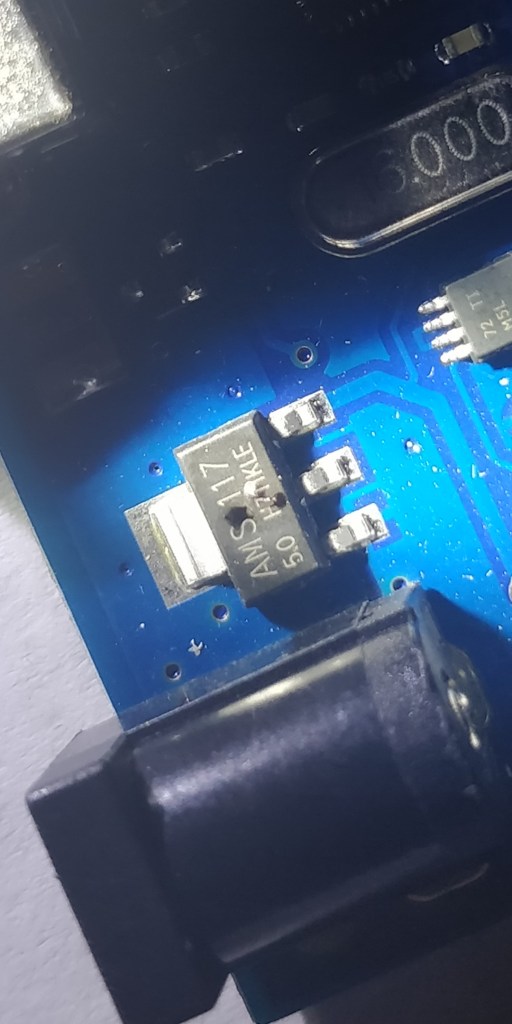
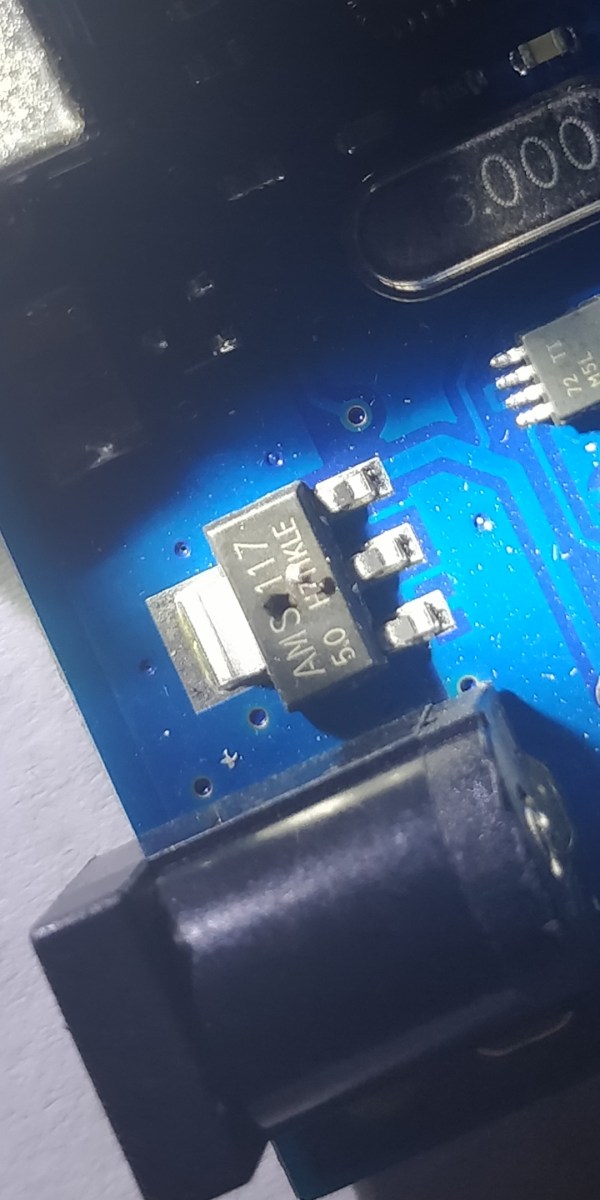
I plugged the heater in and flicked the switch. “Hmm nothing’s happening, well, presumably the heater is working away, and I’ll just keep my ey – something smells good; like Christmas – no, something smells bad; like a burning project.” Something like that went through my head as the scent of pixie smoke and crushed dreams began to fill the garage. Pixie smoke? You might ask. Well, when you buy something like an Arduino, which is basically a little computer, there’ll be lots of little black boxes on them with circuitry that performs a specific function, allowing the little computer to work. These little boxes can contain some fairly complex circuits that do very simple things, however, doing simple things a few million times every second can trick us slow-thinking humans into thinking they’re doing very complex things. People that understand these tiny black boxes in an intimate way are very rare but people that use them every day certainly are not. Usually, when these boxes stop working it’s as a result of something getting too hot inside and melting which also melts the black plastic enclosure and gives off some very nasty smoke. So for all those people that use and break these boxes often but have no need or desire to learn how they work inside, the traditional pseudo-explanation is that they’re all simply enclosures for different kinds of magic pixie smoke which does a specific job. If that pixie smoke escapes, the little black box stops working. Some engineers and hobbyists are cool, though.

One such little black box, the slick looking patches are where the pixie smoke escaped from. Look forward to reading about this failure in a future post.


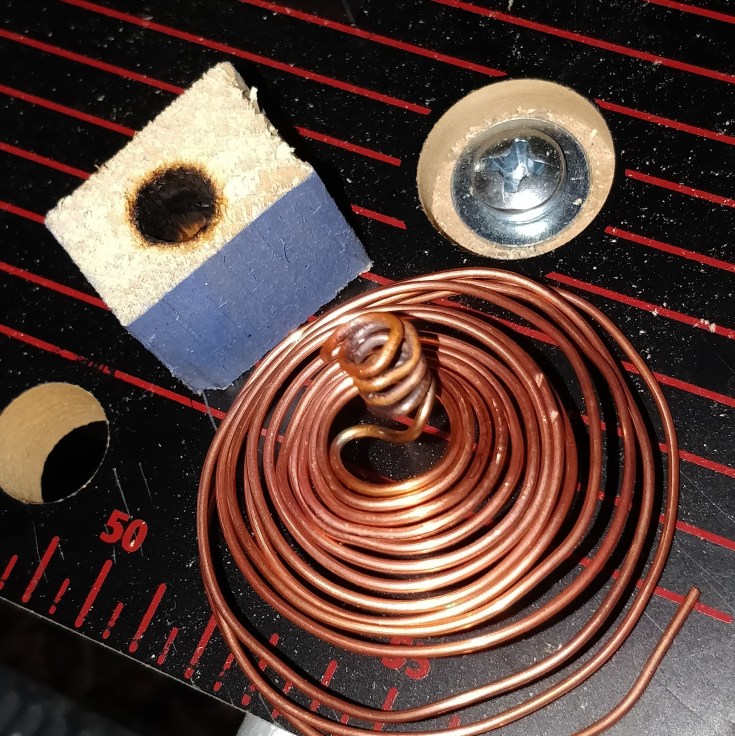
Having put this particular large wooden box together myself I was frustratingly aware of the fact that this smoke signal for failure I was accidentally sending out was not in fact a cloud with mystical properties, rather, it was the result of insulating a heater capable of reaching 300°C with wood. Wood, as luck would have it, generally catches fire at around 300°C. The more you know.

The heater was in the copper spring type part, which was in the wooden block. More wood was used to insulate the bottom of the spiralled copper but it escaped unharmed. Clearly the wooden block pictured though has indeed been very much on fire.


So, frighteningly aware of the fact that this smoke meant I had started a fire, I turned the heater off. Smart move. Smoke and burning persisted though. As you probably know, fire needs two things to burn – fuel and air (oxygen). It was only the inside of the wooden block which was in contact with the heater, so only that part was on fire at this early stage and the snugness of the fit meant that air flow to the embryonic blaze was pretty limited – even though it was surrounded by wooden fuel on all sides; ironically, it was this abundance of fuel that was preventing it from burning by limiting its access to oxygen. Had I Let It Be, it would have suffocated fairly quickly and died off. I didn’t, so it didn’t. Instead I decided to give it CPR, but, in my defence, you blow on a candle to put it out and I’m not sure I’ve ever had to fight a fire in any other situation. So, when I saw this small flame with ambitions of cooking all the food in my freezer (and the freezer too), I instinctively blew on it. It, in turn, instinctively flared up in exultation as it could finally take the breath it had been gasping for since its inception. I decided not to do that again. My second smart move of the day. Instead I watched the fire slowly suffocate and armed myself with a wet sock to finish the job if required, like some kind of sadist. The smoke brought a tear to my eye, but the death of the fire brought a smile to my face – nervous and disconcerted as it was.


Sometimes people that know CPR, that know mouth to mouth, just like me, should keep to themselves.


I did another very quick and cautious test with no wood around the heater and saw it glow red hot almost immediately, which I didn’t like. The problem is that I thought the heat could just go immediately from heater to copper tubing to cup to water. In reality there’s a lot of lagging at every stage and what I need, apparently, is something with enough “thermal mass” to capture and hold the heat from the heater until the cup is ready to accept it. Basically, I need a bigger block of metal as a hot plate and more of it should probably be in contact with the heater too.


I have spent a few days now trying to get copper blocks or aluminium blocks with the exact right dimensions, but they just don’t seem to be available. After hours of sickening myself looking for the perfect block to use I had a moment of weakness, I saw a block of steel that was roughly right and bought it immediately. Immediately after that I realised it was the wrong size entirely and now, even more sickened, I’ve bought a slightly larger one that is actually about right. The problem, though, is that it’s a large block of steel and I haven’t done nearly the amount of research I should have into whether it will be up to the challenge in order to justify buying it. But that’s a problem for when it arrives.


The reason such blocks of steel exist is actually for use as tiny anvils which jewellers use as a work surface as they hammer bits into shape. Some, like what I’ve bought, are just blocks but others are stylised as actual anvils and would make a pretty cool paperweight. But honestly, what even is a paperweight? If you want a desk toy because it looks cool buy a desk toy because it looks cool, not everything has to have a purpose outside of looking cool.

Case and point: Spoilers on your road car. They might never have to actually affect air flow or fulfil any other purpose but they don’t have to. Because they’re just so good at DEFINITELY looking cool, and hey, making you look cool while they’re at it. What an incredibly cool looking thing.

Mastering Entropy

TL;DR: I’m using a relatively low powered cartridge heater to heat the water so that it can use the same power supply as the Arduino. For aesthetics it will be inserted into a sort of electric hob style spiral set up made from copper.

I said previously that some part of my brain had sketched a parts list for this project, however, now that I sit down to materialise that into an order form, it is becoming clear that it skimped on the details. It’s becoming increasingly apparent that a heater, a light and an Uno board does not constitute a parts list for this project. Finding a suitable heater is tricky, thankfully, as I mentioned in my last post, I’m interested in 3D printers.
There was a mild interest before with my uninspired Arduino build but this year at uni I had the pleasure of working to prototype some sensors and anytime something I needed didn’t exist I would just go home, design it and send it to the technician, the next day it would be sitting in a bag with my name on it. Completely bespoke, a perfect solution. Or at least perfect within the confines of my designing capabilities. I defy anyone to not be completely spellbound by 3D printers after having used them to do something genuinely useful. Imagine a world without compromise – if something is too big or too soft or too red, you can just tell this machine to make you a smaller, harder, bluer version. And it will . . . Madness. This obsession will no doubt lead me to buy one and Amazon is keen to be in on the action. I’ll go shopping for a first aid kit and the screen will contain the absolute minimum amount of medical supplies that it knows I’ll tolerate, the rest being a mosaic tile arrangement of: 3D printer parts at low low prices; stylish coffee makers crafted from exotic looking wood and shiny metal; and books that promise they’ll help me get my life together. Amazon really does know me, and now, so do you.
Thankfully one of these printer parts is the heater used to melt the printing material, which I think looks about perfect for heating a single cup of water.

Cartridge Heater
A 3D printer’s cartridge heater

Simply dipping it into the cup as an immersion heater would never suffice though, far too inelegant. Plus, as any Irish person will know, there is a horrible stigma around the use of an immersion heater – the cause of many’s a family argument:
“Who turned the immersion heater on/off?!!”
“The water from the central heating is plenty warm!”
“The shower ran Baltic after 5 minutes, I’ve near caught pneumonia!”
“Our electric bill is sky high because of that thing”
“Tell *insert family member* to quit using their xbox/laptop/electric heater all day if you’re worried about electric, I need a shower!”
Clearly an immersion approach won’t work. I think I could rig the heater up to a hot plate and use an enamel camping mug pretty easily though. I’ll use a copper wire to form a spiral that dips out at the centre to wrap around the heater. Copper also has the benefit of being very nice to look at.
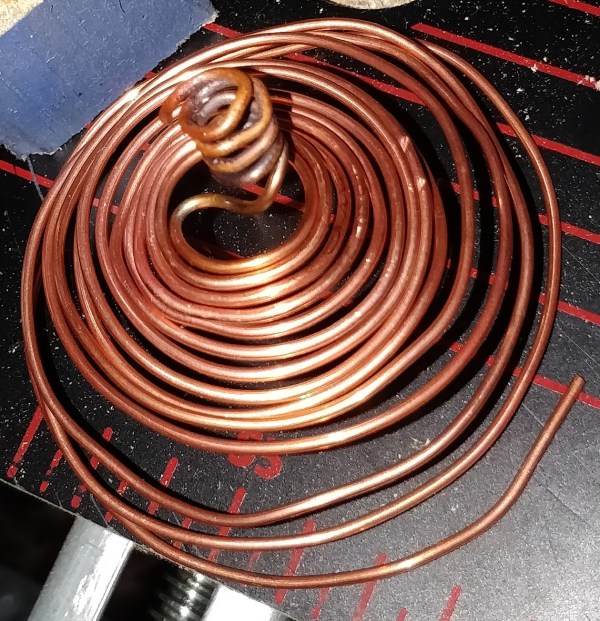
I don’t think I explained it very well at all so here’s a photo:

Copper Wire
An Imperfect version of the copper hot plate – spiralled plate with a small spiral in the middle where the heater snugly fits

The big question is will it work? The heater I want has to be small and take a 12V supply, this limits power to about a 50W, or, 3% of a typical kettle. I could have a heater similar to a kettle but it would require a separate power source as the Uno board (brains of the operation) can only accept a maximum of 12V. So, it’s either cap the heater at 12V too or provide it with power from somewhere else. If an immersion heater approach is inelegant, having two different power supplies wired into the clock is abhorrent.


I’ve done the maths around it a few times and it checks out that a 50W kettle would nearly boil a cup of water in about 20 minutes, which is fine as I’ll be asleep anyway. The problem is, this isn’t a kettle – it’s basically a hob and saucepan, which the internet slates as about 50% less efficient. I’m optimistic though, comparisons on efficiency are difficult to make, especially when I’m building this hob myself and can tweak it to make it more kettle-like. One solution I suppose is to put an insulating sleeve and lid on the cup to ensure it retains all the heat it is given, however, the inclusion of a plastic cup-cover is going to make designing this thing to look as good as it has a right to be (it is a bespoke, hand-built alarm clock after all), considerably more difficult.
For now I know I want a cartridge heater from a 3D printer, some copper tubing (the type used for refrigerant systems) and a 12V power adapter with enough juice to power the 50W heater and an Arduino Uno. I definitely don’t want the heater robbing the board of power.
This is where the mothers lifting cars to save children legend becomes germane, the brain has told the muscles to try and save the child, knowing if things get out of hand it can always take the reigns again and ensure its own preservation returns to being number one priority. It has forgotten, however, that it shares a blood supply with the same muscles it has commanded to perform a very bloodthirsty task. The muscles begin, politely, with their usual allowance of the body’s blood supply but that doesn’t cut it, so they start robbing blood from every other organ in the body, including the brain. The brain is now left with no blood to fuel it. It might very well want to slam the brakes and say hey, we’re in major trouble here, forget about the child, I need that blood to keep us safe. However, without the energy it’s being robbed of it can’t scream its message loud enough to overcome the bedlam besieging the muscles as blood floods into them from all directions. The whole process leaves the muscles torn apart and a brain that has known true anarchy for the first time, now unsure how willing the body will be to return to the dictatorial regime which up to now there had been no alternative to.
In a much less interesting way, if the Arduino turns on the heater which takes 50W from a 50W supply, that leaves nothing for the Arduino, so it can’t send the stop signal until the heater has reached temperatures where it melts its connection to the power supply, at which point there will most certainly be a smouldering puddle of plastic releasing every carcinogen under the rainbow on my bedside cabinet.
All of that isn’t completely true, the heater and Uno have a slightly more democratic way of splitting the power but there’s definitely the risk of a necessary stop command not being sent if the supply is overloaded.
A 60W supply should be fine.


Hussle and Motivate

TL;DR: I have an Arduino Uno from an abandoned project that I want to find a use for, a cup of tea being made will all but guarantee I get out of bed in the morning as opposed to checking my phone. A sunrise lamp is a good feature.

A couple of years ago I bought an Osoyoo (knock-off Arduino) Uno CNC plotter kit with the best intentions of building a CNC plotter from scratch, maybe even fitting it with a hot point to make a CNC wood engraver / house fire starter or a “3D printer pen” in a bid to be able to say I made my own 3D printer.

“I, Caleb Halfpenny, have made the thing which can make all things.”

Or words to that effect. In reality, knowing what I now know about the technology, if a competition broke out between myself with my “3D printer” and a toddler, armed with some Play-Doh, I’d just have to hope the child becomes as distracted by the smell of the clay as I always did. I like to picture the intuition that these projects were ill-conceived and destined to disappoint as a tennis player in my brain. A perfect tennis player guarding my physical response receptors, swatting away the neurons obsessed with this silliness before they get the chance to manifest into the actions that would absolutely and undoubtedly lead me to either burn my house down or be embarrassed by a toddler.
In reality though that intuition wasn’t there at all, those tennis ball neurons never even made it over the net as their server limply set them into motion, holding his racket with the grip of a teenage boy holding his younger brother’s hand to cross the road. The feeling of wanting to keep his kin safe and the overbearing teenage fear of being ridiculed causing the emotional scale to net out somewhere around apathy, but it’s an overwhelming apathy, closer to an anxious, confused impasse than real carelessness. The two sides of the internal tug-of-war are pulling with everything they have but neither can gain an inch, all their efforts merely increase the tension in the centre of the rope.
I wanted to pursue that project so that I could advertise it as some engineering feat I had accomplished independently, which would be great for a quirky interview answer – something I valued very highly then while desperately searching for a placement role. I didn’t want to pursue the project because it would take up a lot of placement application time and I didn’t really have a use for a CNC plotter.
So, I resolved not to build the machine, but the tension in that rope didn’t release, it remained as potential energy; untapped potential energy. Since then the unused Uno board has been as present in the back of my mind as it has been in the top of my wardrobe and I’ve always been keen to finally put it to use.

(Unused) CNC Shields for Arduino Uno

Now, today, I think I’ve found the use for that board. It’s been brewing for a while now; I want an alarm clock to ensure my phone isn’t the first thing I look at every morning and as I considered alarms I grew attracted to the concept of a simulated sunrise and that of tea/coffee preparation. But today the notion hit me that I could make those myself. “Sounds like a nice project” I thought, and went about my business. Somewhere inside though an obsession had began. I realised this myself the next time I went to check in on the idea and some part of my brain had stuck a post-it note to it with a parts list and rough design. Now we’re moving.
The power of having a good morning routine is preached about everywhere and at university it is evident. At university you live on your own terms mostly, if you don’t feel like getting out of bed, there’s no immediate repercussions forcing you against your will. Most days I wake up and go by 9 a.m. at the latest to either attend uni or get to the gym outside of peak hours, this is usually good enough motivation. The weekends though, where I give my body and mind a break are where troublesome habits become clear. I think letting my phone dictate when I get out of bed is a mistake. Using the alarm on it is convenient but it ensures the first thing in my hand every day is also capable of holding my attention for the entire day, and it certainly doesn’t encourage getting out of bed. On a day of low motivation I should be able to rely on my alarm clock to give me a reason to get out of bed. Sometimes the phone does this – a calendar reminder or a text from a friend wanting to go for breakfast, but more normally the phone does the opposite. I can interface with the entire world and live my life through it without getting out of bed and so I probably will, at least until I get hungry or need the bathroom. While I can live life through my phone, I prefer not to, I prefer to get up, enjoy a cup of tea with breakfast and do something a bit more involved like go for a walk at least. The phone has one key advantage in the morning routine though that allows it to win out most of the time – it’s already got my attention. And it sure knows how to keep it. YouTube knows how much I enjoy watching the sun rise so it has to have a bright red icon to catch my attention first. Facebook knows how much I enjoy a good breakfast so it has to bombard me with memes to distract me from my mild hunger. Instagram knows I’d love to get up and be active so it shows me only the prettiest of people, in automatically playing videos and captures my attention before even my own body has a chance to let me know it’s getting restless.
This is for the most part a passive experience though, I don’t actively engage in or even enjoy the morning routine, it’s like talking about the weather – inoffensive and could lead to something better – learning there’s a heatwave on the way, or seeing a post from a friend that shows them having fun. I’ve never went to bed at night excited at the prospect of checking my phone in the morning, or set my alarm for earlier than normal so I can enjoy the first posts of the day in real-time. So I need a wake up call that I can engage with actively, that encourages me to get out of bed, and boiling a cup of water is absolutely perfect for a few reasons:

  1. Starting obvious, a cup of tea has caffeine, which of course takes it’s name from café, which is where a French maid would work. Caffeine being the French maid that walks around behind your eyes dusting off cobwebs when you drink a caffeinated beverage.
  2. I enjoy tea actively rather than passively. One of my favourite things is to bring hot tea to my face and blow on it, basking in the fragrant steam that rises over my face and rejuvenates my eyes. My eyes which I have so cruelly exposed to this harshly arid world again, after a full 8 hours of tranquil bathing under their lids. They get it the worst in the morning, immediately they dry out and so the lids get shut again to spare the pain but they’re already so dry that the lids feel coarse as they close – that didn’t feel right, try again – same result, the pain is too much – I cry slightly, moistening the eyes and hence readying them for another day in this hostile world. This is of course the reason humans cry as a natural reaction to pain, so that the pain of dry eyes in the morning can be alleviated without the brain having to be fully awake.
    I also just enjoy drinking tea, you know, like a normal person.
  3. I, for one, can’t drink lying down. At the least I’ll have to sit up in bed to avoid waterboarding myself with scalding tea. My chest now being exposed from the duvet is good priming for taking that next leap out of bed.
  4. This is the most important point of all, all the others rely on me drinking the tea, what’s to stop me just lying on and boiling the kettle later? Well, I am. If there’s one thing I’ll credit myself for it’s not being wasteful. If that water is boiled it’s being used. I’ll do everything in my power to only use one pot when cooking, to the point where it has to be driven by a desire for efficiency rather than just laziness. Old jeans are now garden-work jeans, T-shirts, pyjama tops. I’ll use books I don’t like as work surfaces (my copy of Camus’ “The Myth of Sisyphus” was cut to shreds while used as a cutting board. Imagine finding a book about why life is worth living shredded with a scalpel on someone’s bedside cabinet, like some sort of violent protest to the concept that life has meaning. I’d be worried. I didn’t disagree entirely with the book, I just found the way it was written to be absolutely impenetrable – of course life has meaning. Doesn’t it?). So the thought of letting all the energy put into heating that water go to waste is . . . absurd.
A model illustrating point 2 in a much more photogenic way than I could myself. By Andrea Piacquadio on Pexels.com

That’s the motivation then, I want an alarm clock that inspires me to get out of bed, so it should make tea. A gradual illumination of the room is apparently the preferred wake up call for the ancient parts of the human body, which I have to assume are the only ones that matter when I’m sleeping, so that will be a nice feature to add. I have the brains of the operation in an Uno board and the ability to program it myself so I’ll just buy some lights and a heater, the thing will practically build itself. I can swap out the cheap looking white plastic housing these sunrise alarm clocks typically use for whatever I please. It’s going to be a great little project to work on and I’ll use the end product every single day. Fantastic!

Create a website or blog at WordPress.com

Up ↑