The 5th Sense

Story So Far: A lamp has been made, a hot plate has been made, some buttons have been made or bought, a clock and an LCD screen have been bought. All has been wired up and programmed. Just need to give it all somewhere to call home.
TL;DR: First and last two paragraphs are on the project/blog, just saying what casing situation is. Everything in between is beyond the realm of tangential and well into just plain irrelevant – why acupuncture works and why smells make for more potently emotional memories than other senses can come up with.

As I’ve mentioned somewhere before, this is a completely hand-built, bespoke alarm clock and has a right to be aestheticised accordingly. The proposed design is below; glossy white plastic casing and a wooden veneer finish on the top panel.  Unfortunately, to make that happen I need two things; the means to make those panels out of glossy white plastic, and the motivation to make an accurate sketch in CAD. Both of these things are beyond the horizon as I look through time from the present moment. Oh well.
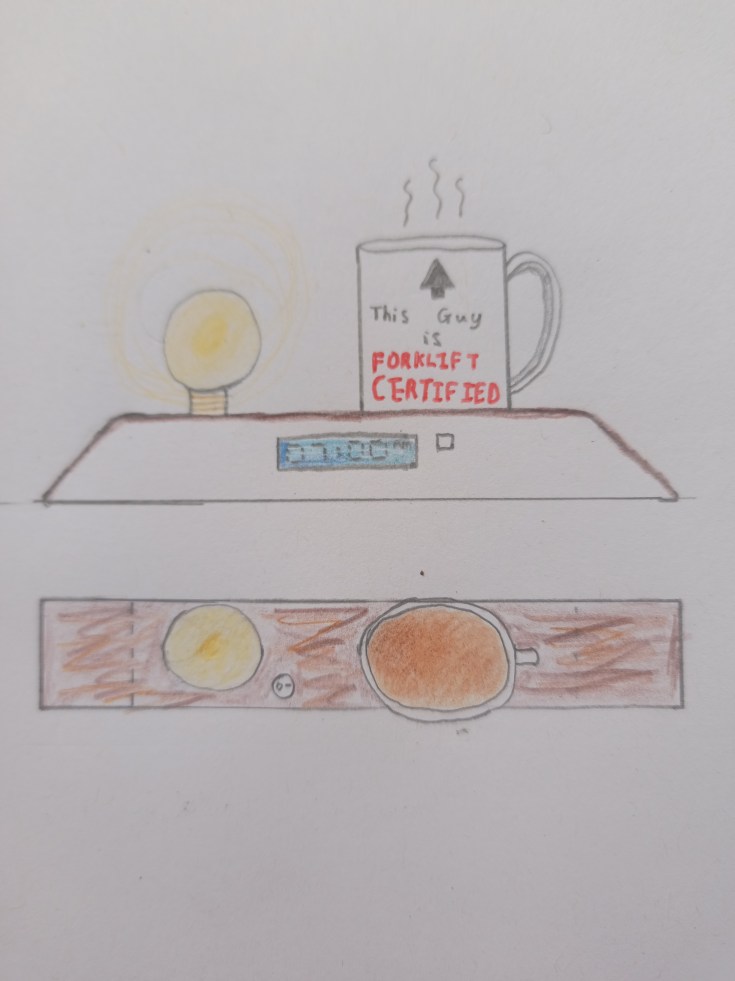
Front and top view of proposed design. Tea should not be this colour.

In the meantime, there’s a pretty easy cop out. A base and four walls made from LEGO with a top panel made from an old floorboard. I like to think it makes up for being utterly tasteless as a piece of homeware by being a tasteful homage to the life-long engineering pilgrimage that has culminated in its creation – there’s something flirting with profoundness in the fact that the first project I’ve done as a qualified engineer is made from the toy that very probably predestined the entire journey. I think that whether the clock, in its temporary form, appears as flamboyant or garish really just depends on how camp the entire project is, on its ability to present itself immediately and unmistakeably as only having been created in the context of itself and the joy it might bring. Given that every post so far involves some sort of technical hiccup and a subsequent compromise, I’m not brimming with confidence that I have achieved good camp; it’s difficult to say exactly what camp is, but it certainly isn’t compromise1. It also isn’t a goal to be achieved and anyone who has ever made it so has failed before they start.

The “finished” product. More or less.

So, what hope do I have of having made something good here? Well, one place there has been no compromise has been these blog posts – self-indulgent and conceited, almost to an onanistic extent, with very little irony. Perhaps then, the project as a whole can be construed as camp, and thus, the clock’s physical form construed as intriguingly vulgar, rather than nauseating and garish. Probably not though. And in any case, my opinion on the matter is the least important of all. Regardless, the Teamaster 2000 blog series is ending with this post, only to be appended to if/when I feel like it. It’s been a good run but, as I have had other ideas, I have developed cabin fever with this project as a framework for my writing. There’ll be a rearrangement of the entire site soon to accommodate different subject matters. For right now though, here’s some unabashed nonsense. Enjoy.

Like for like, if you compare an adequately caffeinated human with a horse, it would be accurate, if a little unkind, to call the horse an idiot. One thing that humans and horses can both recognise though, is that the sensation of the individual sinews in your leg muscles morphing into wound-steel guitar strings that scour one another with each muscle contraction is a sensation that’s probably best avoided. Primarily because it hurts, but also because it probably means that you’re about to shred those strings. In a bad way. But, with modern medicine’s miraculous mastering of human physiotherapy and horse euthanasia, is the risk of catastrophic fissuring worth it? Picture the scene; you’re a delusional jockey. You know your horse is the fastest, you know it can bring home the win, you’re just worried that it might suddenly become aware of the fact that it is tearing itself limb from limb in the process and that that moment of hesitancy before you can whip some sense into the dumb thing will cost you everything. What can you do to prevent this travesty? Well, you could rub your horse with chili peppers. As luck would have it, horses can only feel one of either; a dull, persistent pain (muscle pain, mild headaches, crushing etc); or a sharp, momentary pain (burning, stabbing etc) at any one time. The preference, for survival reasons, goes to the sharp, momentary pain (we can afford to forget about dull aches for the duration of a short sharp pain, but not being able to feel short sharp pains in a place where you have a chronic dull ache might mean you don’t feel it when you get stabbed, or bitten by an insect). So, what’s that got to do with chili peppers? Capsaicin, the “hot” chemical in peppers, is perceived as hot because its chemical structure allows it to bind with the receptors we use to know if things are (thermally) hot. These same receptors trigger an almost identical response to that associated with physical pain and the neural pathways which light up because of heat tend to be of the variety that represents sharp, momentary pain – the same variety which overrides (in a sense, provides relief from) dull aches. So, hear me out; we rub this Stupid Horse up and down with chilis, emulating its immolation, the pain prevents the animal from noticing that it is utterly eviscerating its own muscles, it runs like a creature possessed and ruptures every fibre of its being in doing so, the capsaicin loses its potency, a muscular cataclysm surges through the beast, the on-site vet tells you how much a horse’s lifetime of ketamine costs, the prize money won’t cover it, horsey gets trolleyed to the Temple Grandin temple and they drive a bolt into its head, that night you drink from the winner’s cup and argue with a man in an alleyway about how much ketamine costs. A winner.

Hell of a proposition, and also the reason capsaicin is an illegal doping agent in equestrian sports. The whipping, which is not only legal but crucial, has a similar “numbing” effect though. This also works on humans and is the reason pre-match changing rooms for a variety of sports wreak of deep-heat, and also why acupuncture and massages make you forget about your chronic back pain2.

To my knowledge this Edna Milton quote is fictitious and Jockey Full of Bourbon equally so. It is entirely possible that this is not the case though.

I say all that to say that the science behind human senses is interesting and useful. I also say it because it’s rare to be in a social situation where I get the chance to. Anyway, the sense of touch/pain is fascinating of course, but the sense at the heart of this post is smell. This peculiar sense is uniquely poised to debase our rational-thinking cortexes and annul the “sapien” status we have endowed ourselves with. By this I mean a familiar smell is much more likely to trigger fits of pique than other sensations are3. To illustrate:

Cast your mind back to the last time you lost control – convulsive laughter, apoplectic rage, hysteric crying, etc, all just variations on a theme really. The theme being that even if God had given us free will, there’s still parts of us that have literally no concept of who the fuck we are and, as such, will never bend to that will. For most people, one such part is the limbic system, the captain of our emotions. Most interactions light up our whole brain and bounce around until they finally catch the attention of the cortex, the executive part of the brain, and the part where our sense of self is strong, in this way we can interact in a manner that is “in-character” for us. Some interactions though, make a B-line for our limbic system and before we can think about how we, our grandiose idea of ourselves, feel about something and then go about releasing chemicals to feel that way, our limbic system has already put in motion the production of the euphoric, aggressive, or depressive chemicals in our body. Things like somebody slipping on a banana peel, slapping us in the face, or mentioning a loved one will often trigger this kind of unconscious response. Also, things like smells. Turns out our olfactory system is uniquely linked to our limbic system, so that no matter who we are, or who we think we are, some smells will just make us feel things. Evolutionarily, this makes a lot of sense. People/proto-people who had an innate and immediate aversion to the smell of bear urine probably had a much better survival rate than those who’s biology allowed it to come down to personal preference. Although it is hard to imagine a huge difference between the two groups.

All sorts of things trigger a strong limbic system reaction, but not all of them end up with us curled up, cowering in the corner of the kitchen trying to remember the last time I cried like this? And is it usually this harrowing? And is it happening more often? Is it starting to define me? Did I see it coming? Can I see it coming? What if someone walks in? What if someone calls? What if this happens in front of someone? Is it over? That’s it? Well, okay. Maybe I’ll have a nap.

Well, the difference between a melancholy twang and an all out fit, is how capable your cortex is to retake/steer the reigns. This of course depends on many things, but the events that are truly capable of razing that little neuron nucleation point that endows us with “humanity” to the ground, are those that attack its foundations. The cortex’s entire métier is to rationalise the world through the sensibility of our ego. This allows it to do all sorts of things, most notably, predict the future (rightly or wrongly). Anyway, assuming my immediately-and-easily-proven-to-be-incorrect™ definition of it is correct, we can see that to sabotage our cortex there are two options. We can suppress our ego, which can lead us to be free of the pains of pre-cognition and prejudice and truly live in the moment (for some this is an intentional and spiritual ascent to the pinnacle of Maslow’s Hierarchy, for others, it is a symptom of their unintentional and hellacious descent to the opposite end), or, the world around us can become entirely unrationalisable. Focusing on the latter and circling back to the sense of smell, as you are no doubt attentively waiting for me to do, the memory of a smell can be pretty difficult to contextualise, and contextualising is a pretty big part of how we rationalise the world around us. For example, seeing a familiar actor in a movie, a world where you don’t know who she is doesn’t make sense, it’s irrational, but you just can’t quite say you fully remember her. So, you contextualise the faint memory of her by going to her IMDB and seeing that she had a cameo in Friends one time. The frosted glass you were viewing the memory through clarifies. You turn off the movie that you weren’t that invested in anyway and switch to an episode of Friends you’ve seen more often than your actual friends this past year. The world makes sense again3.

We primarily perceive the world visually, and so context for memories is often synonymous with some sort of imagery. When we encounter a smell and commit it to memory, we also store an image of the source of that smell as context for it. This is then our memory of that smell. But, as time goes on and you encounter the aroma again and again, produced by different sources and in different surroundings, it becomes decontextualised in your memory. So, when you smell cheap plastic, it may remind you of a Kinder Egg, or a ball pit, or a LEGO set. If you still encounter any of those three things on a regular basis, your brain will immediately associate the smell with that item, and you can picture it. If, however, you’ve stuck to the societal norms of growing up, it’s likely some time since you last encountered any of the worthless treasures of your childhood, and a whiff of their characteristic plastic will inundate your brain with a familiar fragrance and the feeling of contentment that you haven’t experienced since you were a child at play. Your head will spin as the scent flares up a limbic system emotional response and the absolute bewilderment induced by the lack of context will only amplify the emotions, your brain has absolutely no idea which visual memory to attribute to this smell and you’re in limbic limbo until it comes up with something. Eventually, when you really try to pin it down, you will come up with a specific ghost of your past to lament over, this is not to say that the smell genuinely most resembled that item, but more to say that you were thinking about that thing, or things adjacent to it, most recently and were primed to land on it.

Put all of the above together and you’ve got a mess of a blog post. Put the bits about olfaction together and you’ve got a sense that not only takes a shortcut not available to other senses to illicit an emotional response. But also, a sense that can make sure that response lasts. Not only has your nose got a head start on your rational brain, but it’s also tied your brain’s shoelaces together.

Confusion, nostalgia, smells – an absolute crisis.

It’s worth pointing out that there are also smells that actually do conjure up a specific image, like if you only ever smelled that weird soft-yet-abrasive carpet that has a texture somewhere between the two sides of Velcro when you were a child lying on the floor of your local library. When you’re hit with that scent anywhere else, it will likely conjure up an image of that weird blue-yet-grey carpet that is almost certainly made from old bus seats in a process that is disconcertingly similar to how pigs (presumably along with other animals) get turned into Billy Bear ham (not a sponsor). This scent may well cause an overwhelming emotional response, but this response is more akin to seeing an old friend than the previously described frantic scouring of memory banks for an image to provide context to a familiar smell.

I say all that to say that I was feeling overwhelmingly nostalgic when I used LEGO to build the casing for this alarm clock. I also say it because it’s rare to be in a social situation where I get the chance to. This post started as a commentary of my emotions and memories as I sat fulfilling a childhood fantasy; playing with LEGO by light of a head-torch, well into the night, cross-legged on the garage floor. But the narrative fell apart pretty quickly so I deleted it all and wrote the above. I’ll be honest, the entire build didn’t work out terribly well. It doesn’t look at all like I envisioned, and steel was a horrible material choice for the hot plate. The steel cuboid will one day be an aluminium (I think) cylinder, and the LEGO/floorboard housing will be superseded. That sentence might well be the full extent to which I write about those updates though. I still enjoy the thought of the build, but I’m over writing about it.
Thanks for reading. While I can’t give any timescales for anything, I can give some details on what the future content of this site will be. As you’ll have noticed, I have a penchant for biology, this will be developed on. I also intend to write short pieces inspired by other stories I’ve heard, either in books or in music or in some other form. As a special case of this I intend to make a page called “Helsabot Fanfiction”. “Fanfiction” here being very tongue-in-cheek.
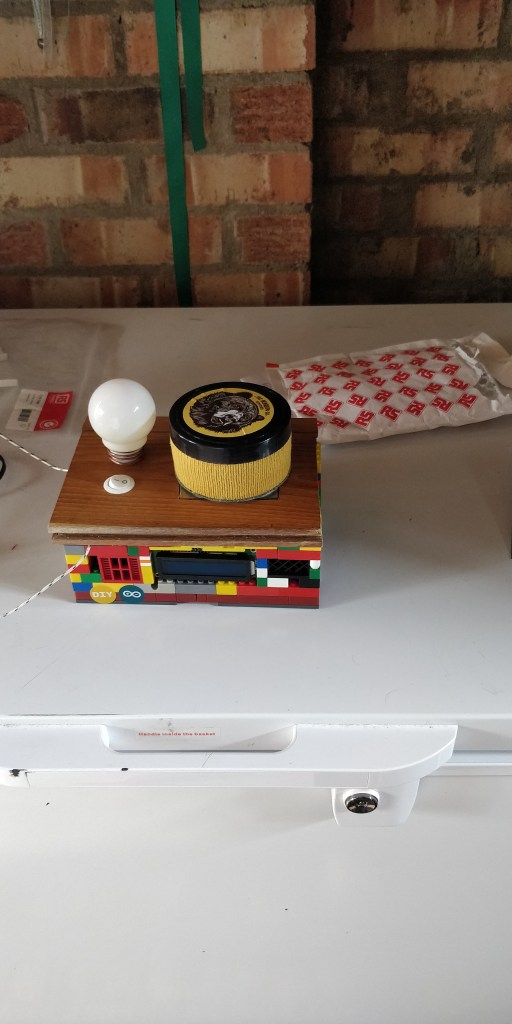
A final, very imperfect photo.

1 – Please read Notes on Camp by Susan Sontag, a “paper” published in the 1960s. Very good read.
2 – I’ve got nothing against jockeys. Also racehorses are generally very well looked after and the events detailed are an exaggeration of the highest order. Horses were indeed “doped” with capsaicin so they wouldn’t feel pain, but if it would be possible for one to run so hard that it gives itself injuries that warrant being put down, I don’t believe so, but I don’t really care to look. I’m very happy to be naive on this issue.
3 – All of this stuff may be entirely wrong, at a high level and at a low level. It’s all accurate as far as I know, but I have a chronic and severe case of Dunning-Kruger-itis.
What All the Howling’s For

Story so far: Key components are working; hot plate made from steel block and lamp made from . . . lamp?                                                    

TL;DR: My Clock tells the time to my Arduino which tells it to my LCD Display. The technical lingo for this communication system is . . . curious. Clocks work by counting how many times a crystal vibrates, your dog can hear the crystal vibrating and hates you because of it.

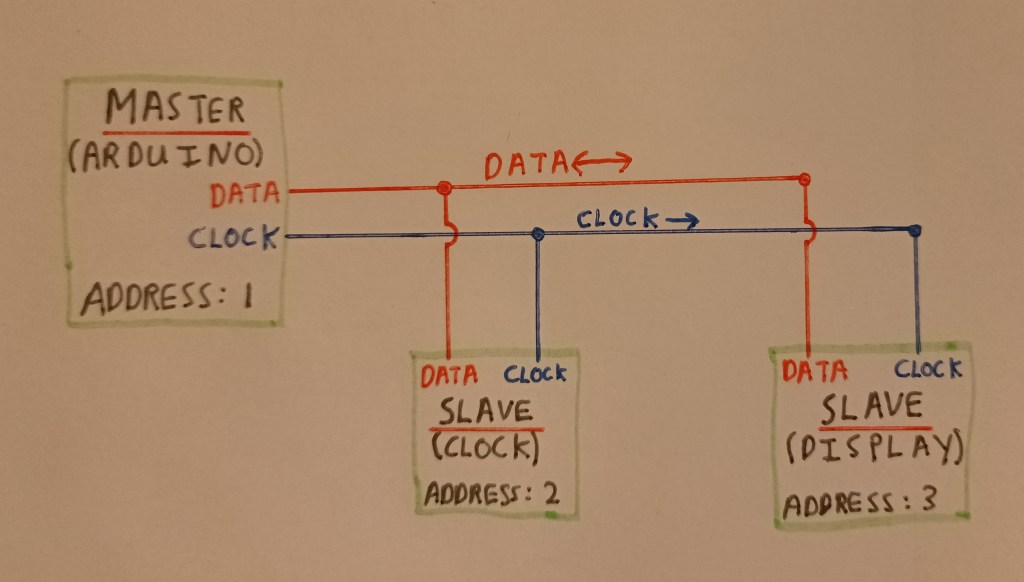
There’s just three more bits of this build to tackle – the Clock/Display, the housing, and the code. This post will cover the Clock/Display – that’s why I listed it first. I’ll start by saying that the terminology for how the Clock and Display get wired up is one of the more curious examples of engineers anthropomorphising their hardware, presumably in lieu of friends (as per this entire blog series). The picture should make it clear what I’m talking about.

A model for “I2C” communication. Arduino “master” can communicate with its “slaves”, the Clock and the Display, through the red data line.

Yep, we don’t just have a controller and its peripherals, we have a master and its slaves. I regularly think about how that ever became the accepted nomenclature and am yet to make it past the incredulity of asking “How’d It Get So Scandalous?”. But Stay Woke, there’s a few examples of leaving these terms behind, most notably, the Python programming language now refers to “parents” and “workers” instead. Personally, I don’t see anything inherently egregious about the terminology, I just find it incredibly strange that those terms were the ones that stuck. It’s also worth pointing out that any brands that have changed their vernacular seem to have done so as a result of the same single court case in Los Angeles. So, while it’s easy to assume that complaints are a result of forcing the wrong context onto the situation, the aforementioned single court case may be a result of a single particularly flagrant use of the terms.
The rest of the story is oh so very L.A. too. I put it to you that nowhere else on the planet would a complaint centred on an African American person feeling offended at the use of the term slave be countered by a complaint centred on a person involved in “the BDSM sub-culture”, who feels offended that someone feels offended at the use of the term slave (presumably outside of certain contexts). But that’s what happened. Among other things.

So, anyway, how that circuit works – the Arduino master shouts the address of the slave Clock down the red “data” line to tell it to listen up, and then asks it for the time. The Clock obliges and sends the time over the data line to the Arduino master’s address. The Arduino master then shouts the address of the slave Display down the data line to tell it to listen up, and then tells it to display the time. The Display obliges.
The blue “clock” line is just used to keep everyone in sync and has nothing in particular to do with the actual Clock, or anything I feel like writing about, really.

Aside: The Display is blindingly bright and so it will be asleep most of the time. Subsequently, I made a touch sensitive button to wake the Display, but I don’t think I could write anything about it that I would ever want to read. So, I won’t write anything about it.

There is one more vastly interesting topic that has a place in this blog post, however, and that’s the Clock itself. How does it know what time it is? The method below is true for pretty much any clock that has a battery or other electric source1 (including your phone1, watch1 and microwave).

The functional part of the Clock is a little tiny quartz tuning fork. A tuning fork is just a tool that vibrates at a specific frequency when you hit it – when it vibrates at a specific frequency, that creates a sound of a specific pitch.
The quartz tuning fork in your battery-powered watches and phone is set at a frequency of or above 32,768 Hz – too high of a pitch for you to hear (also too long of a number for you to read, I’ll say 32K from now on). This makes sense, I mean, if I wanted to hear my phone make a high-pitched whine all day, I’d call my girlfriend, am I right fellahs? Ha. Got ‘em. Nah that’s a joke, I don’t uh have one of those, like, you know, a girlfriend, or whatever.

Notably though, that frequency (32K) is about the same as an average dog whistle, so keep that in mind the next time your dog seems a little restless – your watch is like a very whiny fly buzzing around their ears1. This is another classic pitfall of anthropomorphising things – forgetting that humans and animals perceive the world very differently. I still wouldn’t worry too much about it though, I can’t imagine the noise is very loud. It is certainly audible, though, otherwise we wouldn’t have bothered to design these things to vibrate at a frequency we can’t hear.

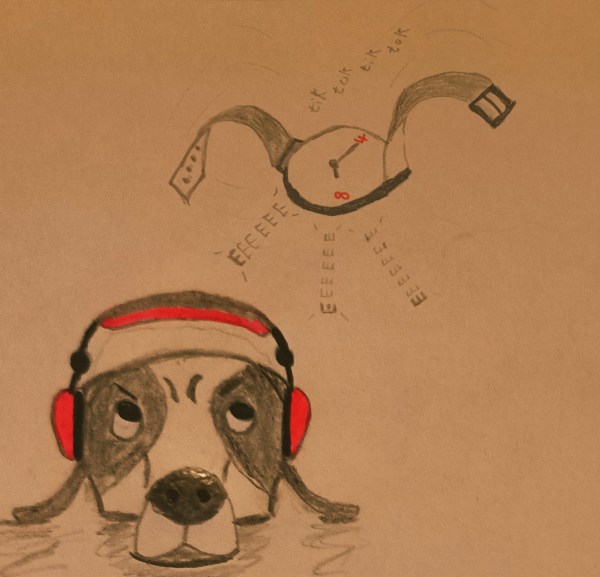
“Artist’s” impression of a dog being bothered by a particularly irritating vivified watch. For commissions email contact@calebhalfpenny.com. 😉

Anyway, the important part about these quartz crystals isn’t that they make sound, it’s that with each vibration, they also generate a small pulse of electricity. Since this pulse of electricity happens every vibration, and we know there’s 32K vibrations every second, we know we need a circuit that adds one second to the time for every 32K pulses we put into it. If that sounds like a fun thing to learn about, you can go search for info on “edge-triggered flip flops” – be warned though, despite their name, they’re no day at the beach. Unless you already have a grasp on binary signals2.
So all we do is give the Clock a starting time, AKA setting your watch, and start it. It’ll then count from 0 up to 32K over and over again, and every time it returns to 0, it’ll add a second on to the time. Then there’s a whole mess of gears and/or circuitry that keeps track of how to display that as minutes and hours. Truly though all the Clock is doing is counting how many seconds have passed since the time it was set. And THAT’S THAT.

Except for the most interesting part! When we hit a tuning fork, the noise eventually fades to nothing. A similar thing happens with our electrical pulse from our quartz tuning fork. So, we need to keep hitting it. Except we don’t. We don’t hit it at all. We actually zap it with some electricity because in a similar way to how our quartz crystal produces electricity as it vibrates, zapping it with electricity makes it vibrate.
So, we start by zapping the crystal with electricity to make it vibrate, this gives us the regular pulses of electricity that we’re after to keep track of the time. The clever bit is that we also tap off a little bit of that electricity and amplify it, then zap the crystal with our amplified electricity to keep it vibrating at the right frequency. If the ability to understand a quartz crystal clock circuit was the only thing that came from my engineering degree, it’d probably still be worth the fees. These circuits are what make me tick. Ha. Got ‘em. Nah that’s a joke, I don’t uh have one of those, like, you know, a way to pay off university debt, or whatever.

Left: Here’s one I made earlier. An uncovered quartz clock from an old phone of mine. Pretty cool.
Right: A very questionable illustration of the time-keeping circuit. When a small electric pulse is given to the amplifier by the quartz, the amplifier allows a large pulse through from the battery to sustain oscillation of the quartz.


The concept related to quartz producing electricity as it vibrates is called piezoelectricity3. Pronounce that literally however you want to whenever you say it out loud, just do it with conviction. That’s what everyone else seems to do. Resonance also has a pretty big role to play in all this. It’s a cool thing.

That’s about it, now we have a circuit where the Clock is constantly counting the seconds and telling the Arduino the time, and the Arduino is constantly telling the LCD Display to display that time, but the Display can’t actually do that unless I touch a button to wake the Display.
Also, if you lose your dog whistle, hold your watch up to a microphone4. Also, also, don’t kink-shame.

  1. Except that I make a lot of reference to the 32 KHz type of crystals. These are very common, but for something like a phone or a smartwatch, the crystals actually vibrate at a much higher frequency. Generally, this means the tuning fork can be made smaller, leaving more space for an extra camera lens or something that can be marketed better. The rule of thumb that I have completely made up is that if you can reasonably say that something is a computer, it probably doesn’t use a 32KHz crystal (and a dog probably can’t hear it).
  2. Each flip flop changes state only at the rising edge of its input. This way, each flip flop outputs electrical pulses at half the frequency of the input. Halve 32,768 Hz fifteen times and you get a frequency of 1Hz – or the frequency of a clock’s second hand.
  3. Piezoelectricity isn’t my forte, but, as I understand it, the crystals get designed so that some inner structures are positive and some are negative. To the outside world these charges balance out so we don’t get something like a battery or a metal. But if we deform the crystal (by hitting it or electrocuting it), these inner structures shuffle around a bit such that the charges are imbalanced in some areas – electricity is made. I think.
  4. This won’t actually work. Microphones are typically designed to only pick up signals that humans can hear and even then they often miss the higher frequencies. I only say this so you don’t think your dog is being deafened by a person holding a microphone in their left hand.

Do You Have Ppe for Drilling Steel?

Story so far: The light circuit is working, so I can simulate a sunrise. The tea-making aspect remains to be seen to.

TL;DR: I drilled into a steel block and put a cartridge heater inside, the block is now a hot plate.

Following from the flaming failure of a first foray into hot plate building, a complete rethink was thunk. Now, I shall simply drill a hole into a steel block and insert the cartridge heater. The heater can do its thing until Tha Block is Hot and then the block can heat a cup of tea for breakfast. Seems reasonable?

The first step is to drill a cartridge heater sized hole in a steel block, that is, drill a cylinder of about 0.5cm diameter and 2.5cm depth. For reference, imagine a standard antibiotic pill in your hand, you know, half red, half yellow capsule full of feel-good, perfectly reasonable to be swallowed whole, as per its design. Now imagine the obtrusively sized, obtusely designed choking hazard that it morphs into the moment it leaves your sight and enters your mouth; that’s about the size of the cartridge heater.

A steel block and small heating element
The drilled hole and the heater, both lined with thermal paste.

Drilling a hole that size into steel with a hand drill is no routine procedure. Learning the correct method required substantial trawling through the unchartered waters of random forums and subreddits, where each comment further verifies the Big Fish Theory; expert metal workers are exposed as mere novices by increasingly snide remarks of “Um, actually…” that are as lacking in self-awareness as they are in relent – at least until someone mentions Hitler. Unsurprisingly, the omnipresent Mariana Trench of knowledge, YouTube, was also explored. One of the titans of the platform, Gus Johnson, was there to provide his trademark well-founded, rational and at times even cheekily comical interpretation, just as he has done for the trials and tribulations of the working man in America; the toxic lack of empathy that infects the landscape of Google reviews; and the decaying state of our natural world as we stray further from God. The video I speak of, though, is of course “Gus Johnson Sings an Entire Conway Twitty Album”.
Bus croons:

You want a man with a slow hand
. . .
You want somebody who will spend some time,
Not come and go in a heated rush

This pretty much sums it up. If you use a very high speed, you’ll initially drill through by scraping lots of very fine steel filings away, however, eventually you’ll end up with a thick, impenetrable layer of these filings at the bottom of your hole and all you can do is move them around and get them into a heated rush – blunting your drill bit in the process. What you want to do is keep the rpm low and apply as much pressure as you can downward through the drill bit. You’ll know you’re Doin’ it Right when the steel you’re cutting away starts to slither up the thread of your drill bit as continuous and spiralised serpentine articulations – acquiesced entirely to their charmer.

It really does require you to spend some time with it, baby. The hole I drilled took around 2 hours and it wasn’t light labour either! At first, I tried summoning every ounce of force I could muster from my arms and pushing down on the drill, whose response was to summon the spirit of Laura Les and subject me to the harshly shrill, yet somehow enchanting dissonance of the bit turning in place fruitlessly – thus reminding me that my arms are indeed like very roast-able little cigarettes. Ultimately the only way I could pile enough force behind the cutting edge of the drill bit to make it carve through the steel was to lie myself atop the heel of the drill and push my weight through it. While this was effective, every force has an equal and opposite reaction, and here I am pushing down through my sternum with enough force to continuously carve steel. You’d think with a name like sternum it’d be made of sterner stuff but turns out this process got pretty painful pretty pronto. So, if you ever want to attempt something similar make sure and check the checklist below.

PPE For Drilling Steel:

  • Goggles (Fine particles and smoke from burnt lubricating oil are both pretty bad for your eyes.)
  • Gloves (Brushing away metal swarf with bare hands is pretty much the exact same as rubbing a cheese grater.)
  • Chest Cushion (Place between sternum of driller and heel of drill to avoid bruising your chest the way you did after watching Tarzan for the first time.)
Some drilling equipment
The required PPE, plus a good example of the fine swarf you want to avoid creating. You can’t avoid it entirely. Bonus: Always have a hammer on hand.

Of course, all that list protects is your body and the many emasculating mistakes made along the way raise the question: Do You Have Ppe for Self-Esteem? Well, personally, I vacillate between immersing myself in music where I can imagine myself as the audacious and brazenly immodest protagonist and lamenting over music where I can think, “well, at least I’m not that guy”. Each the type of music that concerns itself so singularly with one pole of the human experience, disregarding disaffirmations so indiscriminately, that to tell someone you enjoy it is to sully their notion of you with an apprehensive perplexity regarding the lucidity of your perception.
Music to count marbles to for those who don’t get it, music to hide marbles to for those that do.

Anyway, that’s the heating block done, in a very uneventful series of events I coated the heater in thermal paste and shoved it into the hole then turned it on. The block got very hot and all seems good. Onwards.

A cup on top of a steel block
The “finished” product. If you’re thinking “wait that block is far too big for efficient heat transfer!”, you’re right. I’ll address it when I’m good and ready to face up to my mistake.

Turning on the Bright Lights, Part Deux

Story so Far: See Story so Far and TL;DR sections of Part 1.

TL;DR: My circuit needs another resistor or it will continue frying everything. It claimed another few victims before I realised this though.

After the traumatic experience it had endured I decided to give the laptop a break for a while and instead maybe check up on my circuit wiring. We were well into the evening now and the garage was engulfed by the umbra of the garden hedges, but I had been using the head torch all day, so had to switch it to the dimmer mode to save energy. The dimmer works exactly how I described dimming LEDs in “The Impossible Dim” except badly done whereby the flicker is pretty noticeable, giving a slight stroboscopic effect. It was annoying, but still better than being stuck in the dark before I finished. I rewired my circuit and gave it juice, same problem as in part 1, light comes on but just stays at full brightness. I had pretty much exhausted my troubleshooting list at this point, so I let the lamp stay on and willed the problem to make itself known. The “warm” white lamp really gave a much more homely feel to the workstation than the migraine inducing “Transfiguration of Christ brilliant” white headtorch LEDs.

The cooker hood bulbs being used in the lamp meant it gave off that special hue of light that is enriched with nostalgia. Nostalgia for all those nights having went straight to hurling training after school and arriving home battered, bruised and seeking comfort. Finding it wrapped in foil on the stove top. A home-made dinner that had watched on while everyone else enjoyed their meal and discussed their day; during post-dinner clean-up it was lovingly wrapped up in foil so as to capture a healthy serving of the Family Table spirit under there with it. Then as I land home, I am welcomed by the working-class cloche basking in the warm glow of the cooker hood bulb; a glittering, scintillating treasure trove. I approach the light through the darkened kitchen, with each step forward my shoulders bob up and shrug off more of the day’s tension, and with each breath inward the scents of the kitchen build hope for what might be waiting. I reach the stove. Quick breath in. Hold it. Lift the foil . . . pork chops. Stuff that I’ll have porridge.

Yep, the light being given off by the bulbs was lovely, but I wasn’t so keen on the smell – the smell?! . . . suddenly the illusion of homeliness came crashing down as the scent of melting plastic made itself known. I glanced down to the workbench and the strobe of the headtorch made the pixie smoke1 cast a large, jittery shadow, giving the illusion of a much larger plume of smoke billowing out than there was. I’ll blame the ensuing overreaction on that.

I immediately switched the supply off and for absolutely no rational reason whatsoever began ripping my circuit apart. I believe I believed I was protecting the components from being harmed by the now disconnected and harmless power supply. All very silly behaviour. The only component really in use was the FET (the “dimmer switch” that the Arduino was supposed to be controlling). Now, there’s a couple of conditions where a FET will get very hot inside and try to get rid of that heat through its back panel; I had created one such condition2. To get rid of dangerous levels of heat the small back panel of a FET often requires a larger heatsink3 stuck on to it, I didn’t have such a tool attached, that is, until I tried to grab the FET and disconnect it. At that moment, my hand became the additional heatsink and the FET did its utmost to utilise it, sending whatever heat it could into my fingers. Very painful. Very very stupid. Very very very educational.
So, in summary, things fried in an attempt to build the simplest part of this alarm clock:

  1. Laptop’s USB port
  2. FET
  3. My fingers
  4. My brain
  5. Voltage regulator chip on the Arduino

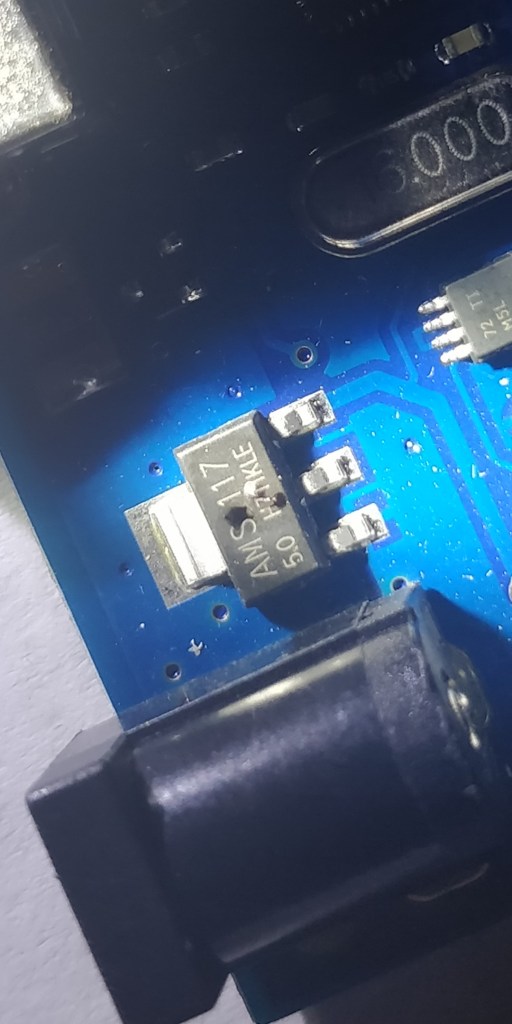
The last of which was what had actually been producing the pixie smoke earlier. It takes the 12-Volts from the supply and steps it down to 5-Volts for the bits that like to work at 5-Volts. The only one of which I was using at the time is the pin controlling the FET. I had pretty much shorted said pin to the ground which meant it was trying to draw Unlimited Power (infinite current more specifically but Star Wars). That power was (obviously) too much for the wires in the voltage regulator to carry so they started trying to get rid of it by heating up their plastic casing. Which melted.

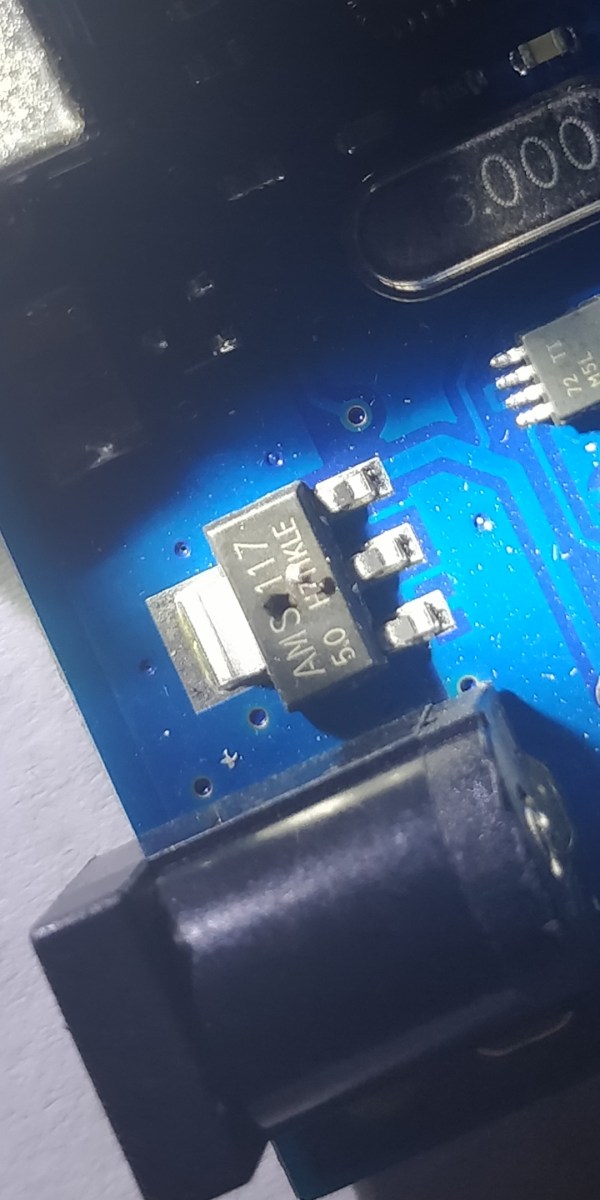
Slick patches on “AMS 117” chip are the bits that melted especially well.


The fix is very simple; add a resistor to the wire. All this is like dropping a watermelon off a 45-metre tower. As it falls it will get faster and faster, creating self-destructive carnage when it lands. Adding the resistor is like giving the melon a parachute, it limits the amount of speed the melon can gather on its way down to the point where you can drop it all day and not see red.


My short-sighted shorting had one more side effect; it had actually caused a failure inside the FET which meant it no longer operated as a dimmer switch and instead had become just a lump of metal, or a dimmer switch stuck at its maximum brightness4 hence the issues I was having. I suspect things got quite hot inside the FET and some tiny bits melted together, only to be cooled down by passing their heat off to my fingers.


After making sense of everything I ordered a new Arduino and repeated the experiment, now incorporating an appropriate resistor and new FET, the lamp works perfectly, dimming and brightening at will.
Incidentally, I referred to the Arduino as an “Uno board” in early blog posts, said posts were written before this Series of Unfortunate Events, at a time when I was using the Oosoyoo Uno (a knock-off of the Arduino Uno) which now, as you know, has a burnt-out voltage regulator. After the events detailed above, I figured I’d like to splash out on the real deal Arduino model. Started From The Bottom Now We’re Here.

1 – See previous post “Mouth Function Malfunction” for etymology of “pixie smoke”. Suffice to say it’s a quirky term for smoke from electronics.

2 – FET == MOSFET for the sake of this blog. My FET wasn’t for microcontrollers – the gate voltage should have been much higher than 5V to fully turn it on. Since I was only giving it 5V it was only partially turned on and still had quite a large resistance. Thus it was a resistive heating element, melting itself and giving off heat. It is now switched out for a “logic level” FET. 5V turns it on all the way – assuming my pwm frequency isn’t ridiculously high, apparently this can lead to the gate not having time to fully activate every cycle.

3 – A heatsink is just a block of metal that absorbs heat from a component faster than the air around that component can. It then has a large surface area in contact with the air to pass that heat on to the environment effectively. It then keeps on wicking heat away from the component. The more surface area exposed to air it has the better at its job a heat sink is – this is why they almost always have a finned design.

4 – I know that’s not quite right as the FET isn’t a dimmer switch in the classical sense (a potentiometer) but it’s accurate enough. More accurately the FET became just another bit of wire in a circuit with a 12V source (wall wart) and a 5V source (digital pin) powering 2 LEDs.

Just a reminder this is what the end circuit will now look like. Except the pins aren’t accurately labeled and there’s a grounding wire omitted. I think the omitted wire is superfluous anyway though.

Turning on the Bright Lights, Part 1

Turning on the Bright Lights, Part Deux” is also live.

Story So Far: Heater prototype didn’t work, waiting on alternative parts. Playing with using pwm (unimportant technical term) to control some LED bulbs for the lamp.

TL;DR: I set up a dodgy circuit to test the lamp part of the alarm clock. Plugged said dodgy circuit into my laptop and gave the PC a fairly debilitating case of agoraphobia. Shock therapy not advised.

I think experimenting with the lamp made for a high-octane chain of disasters so I think I’ll use a sort of dramatic retelling to detail how I transcend the limits of my single-headed human form to fit so much stupid in. How Does That Grab You, Darlin’?

While waiting on new parts for the new heater I figured I could work on the lamp, this would have to be addressed at some point anyway and it would be a nice proof of concept for the heater circuit as they are identical in all the ways that matter. So, out to the garage I went, full of misplaced complacency and bright ideas about this lamp. I set up a very simple circuit1 which is stylised to be even simpler below.

Left: Stick person controls dimmer switch for light bulb, powered by car battery
Right: Arduino controls current flow through a MOSFET (3-legged box which I forgot to label) to control the lamp circuit, powered by 12V supply


After having set up the hardware I had to tackle the minor issue of the software; just a little bit of code to make the lamp brighten/dim brighten/dim repeatedly. My laptop had been enjoying a well earned rest up until that morning – it’s a coin toss between it and the kettle for hardest working appliance throughout my final year of uni – nonetheless it sprung to life right spritely like and was ready for a new project; like an over-zealous sheepdog pup; keen to impress.

Brightness of the lamp is on a scale of 0 – 255 so I set about writing code that would peruse said scale up and down at intervals of 5, updating every second.

Once the code was written, I began uploading it to the Arduino. The Arduino blinked intensely and thoughtfully while it tried to comprehend its instructions and commit them to memory, then, once it felt it had a grasp on them it returned to its steady state; a bright-eyed thousand-yard stare2. This vapid expression concealed a mind that was furiously rehearsing the instructions which now constituted its entire raison d’être. The only thing that could interrupt this fervent meditation was the command to effectuate these orders and begin actually making the world a brighter place – just waiting on the word “GO”. Like a well-disciplined (read indoctrinated) soldier, not yet jaded by combat. The word “GO” in this case was me hooking the Arduino up to the big ol’ 60-Watt power brick. Using a 60-Watt supply to run a circuit this modest is a bit like using a forest fire to dry your hair but I’m told that the Arduino knows exactly how to keep its distance and not get set alight so I went ahead and gave the order anyway.

Turn on the Bright Lights


The lamp came on immediately when connected and was beaten only by my celebratory smile for brightest thing in the room. However, for every second that passed without the lamp getting any dimmer, my expression picked up the slack; finally my face was furrowed and frowning in equal measures at the failure. My first guess was that there was a bug in the code and the brightness level wasn’t updating as it should. So, I opened the laptop and started rewriting the code in a more obvious, less succinct way. Just by habit at this point I had also disconnected the lamp from the Arduino.

At this point I had both the big ol’ power supply from the wall and a USB lead from my laptop going into the Arduino and as I reconnected the lamp circuit it came on with that same, persistent full-beam of failure . . . the garage didn’t seem all that much brighter. Not metaphorically or anything. It was because my laptop screen had gone to sleep at the same time. I hit the space bar a smack to wake it up again (and perhaps vent some anger at my incompetence), but the screen remained black. Interesting. Immediately I ripped the USB lead out from the laptop. Intuitive. I turned all off and began CPR on the laptop. On-button compressions triggered a gasp of air through the fans but it still remained unresponsive, after 40 minutes of poking and prodding we had him back and fully lucid. The diagnosis was that a rush of current from the Arduino into the laptop’s USB port triggered some sort of safety feature that protects the motherboard; this feature cuts the machine off from the outside world until a certain secret knock on the power button lets it know the coast is clear. While researching it I discovered “USB killers”; pen drives that when plugged in, give a massive shock to the motherboard to try and fry it and brick the target machine, honestly, that’s their only purpose – a perfect, pocket-sized example of man-kinds malevolence. I’m glad they exist though because if they didn’t the safety feature I triggered might not exist and my laptop could very well be toast right now.

Turning on the Bright Lights, Part Deux” is now live to conclude this part of the build.

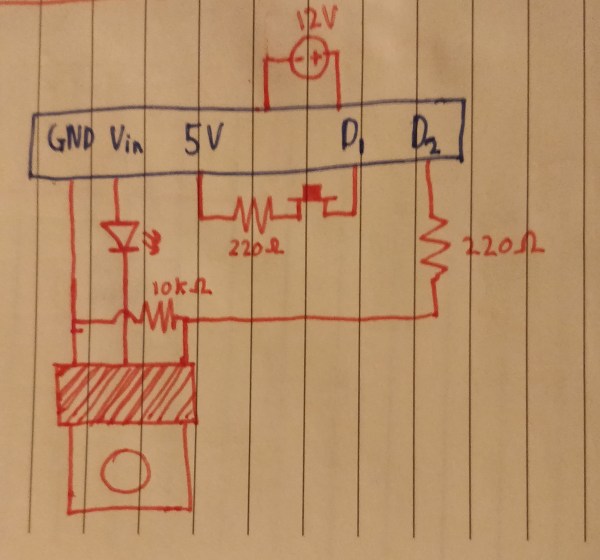
1 – If you’re technically inclined, the actual circuit I ended up using is drawn and carelessly discussed below. In the picture of the physical circuit up above though you can see I only have one resistor in *spoiler alert for part two* it’s not the important one.
2 – Arduinos actually do have an LED that blinks while they load up with new instructions and then switches to a fixed on state to show it has accepted the new code. This isn’t just me rambling. Let me try again. This isn’t just me rambling.

Probably the final circuit schematic

Blue box = Arduino
Red box = MOSFET
Basically Vin will put 12V across the LED light when the MOSFET is set as a short circuit. The MOSFET will be set as a short circuit when its gate pin has a voltage applied to it (when pin D2 is high [It won’t be pin D2 in reality, it’ll be one of the pwm pins to allow variable brightness]). There’s a 10 K-ohm resistor from gate to ground on the FET to avoid floating states. The two 220 ohm resistors are just current limiting resistors. D1 will be polled continuously, if the button is pushed, D1 receives a signal from the 5V rail and the Arduino toggles the state of the lamp (fully on/fully off) as long as it isn’t already in the middle of brightening the lamp for the morning routine.

The Impossible Dim

Story so Far: Original heater concept is a no-go as copper tubing can’t absorb/hold/make use of enough heat. Currently awaiting steel block as alternative. Sunrise lamp is unaddressed as of yet but parts are present.

TL;DR: Digital screens let you keep writing when there’s no space left, this can get messy. Digital screens flicker but our brain blurs the world around us to suit itself. Time is pretty crazy, right?

Notice: This ended up very long and took an age to write. Future posts to be planned out better and split into smaller, more frequent ones. Just a bit carried away with the subject matter is all.

Ever tried to take a photo of a digital screen? How come your eyes see 08:20 but your photo is just a blank screen? Or how come there’s black lines going through your photo of a TV screen? Well, Let Me Blow Ya Mind. And also take a meandering route to explain how I’ll make “non-dimmable” bulbs dim/brighten. Basically, a digital clock works like:

>>Check time

>>Clear screen

>>Reset cursor

>>Display time

>>Repeat forever [Forever ever? Forever ever?]

Clearing the screen is absolutely essential every time in case the time changes – if you try to write a 7 in a position where there’s an uncleared 6, it’ll end up as an 8; eventually the entire screen will just read 88:88 forever and this broken clock won’t ever be right, never mind twice in a day.

6+7=8

Resetting the cursor is another crucial part, it’s the same as pulling the carriage return lever on a typewriter except there’s no satisfying mechanical process or rewarding ‘ding’ to announce to the world that you have crafted yet another page-width of art. Typewriters also include a lock that prevents you from typing on at the end of a line and ensures you actually hit the carriage return lever, without such a lock us idiot humans would likely try to type on at the end of a line and shift the carriage to the left one too many times. That would fling the carriage from the typewriter, casting it out of its homely cradle and into oblivion and you better believe it won’t go quietly either, dragging your page of so-called art with it – a spite-fuelled punishment for your ignorance.
Now the type hammers will still strike the ribbon and stamp out their impression in thick, black permanence but there’s no paper to print on. And so, the letter-shaped manifestations of viscosity are projected into the wind, at the mercy of Aeolus. At their most ruinous these letters may land on a nearby book and construct upon it destructively, ruining the literature’s original meaning. At their most harmless, they may land on the reem of paper next to the typewriter, attempting to author a composition of their own.

Point being, digital screens don’t have such a lock. If you attempt to keep writing after the end of the screen is reached, the program will just throw the letters wherever it pleases. Their new allocated address could represent a random spot on the screen, which isn’t so bad, however, if the program is feeling especially malicious it could write them to a part of the memory which houses something important. Something like how long I want the program to run the heater for – for obvious reasons, this would be a disaster*. So it’s important to reset the cursor to the left [to the left].

The problem created by all this is that digital screens spend a not insignificant amount of time not displaying what they’re supposed to be displaying. Cameras with a high enough shutter speed have a fair chance of catching the screen while it’s blank or in the middle of being populated. TV’s do something similar but split their screen into smaller, more manageable horizontal strips and refresh each of them with their share of the next frame. That explains why TVs can appear to have black stripes across them in photos. I’m pretty sure there’s more at play than that but this is where my interests end with it for now. How come we don’t see screens refreshing with our eyes? This is the interesting bit, it’s also where my writing gets a little scatty because I’m overwhelmed with the implications of the topic, I will return to this topic with a more coherent narrative some day.

Gamers will know that humans view the world at about 60 frames per second** – that is, our brain takes a sample of the landscape of light around itself, using our eyes, every 60th of a second (Not quite true, see**). This is fast enough to make us think we’re seeing everything, all the time. Yet we don’t see screens flickering on and off all the time. Well, the screens flicker much faster than every 1/60 seconds and when that happens, all the things in between our samples ‘blur’ together. You can demonstrate this with your phone – decrease the shutter speed and photos can be made to appear blurrier, which is useful to capture motion, blurring something moving fast or blurring the background to convey movement in a still image is no doubt something you’ve seen and appreciated before.

Slideshow: ‘Sea’ the effect of decreasing shutter speed while photographing a video of waves. Longer exposure time means more of the frames blur together and the sea appears smoother/calmer (picture 2 vs. picture 3). Picture 1 shows a very fast shutter speed capturing the horiszontal lines of pixels which are being cleared/altered to show the next frame. Picture 4 shows what happens with a very slow shutter speed. Too much light is blurred together and it just appears as a bright mess.

So, when a light (or screen) flickers on and off faster than 60 times per second, the in-between bits blur together.*** For example, if you flicked a light on and off very quickly, your brain would blur the on and off states between samples and actually see a light that was on all the time but only at half brightness. Similarly, as long as a screen displays what it’s supposed to most of the time, that’s what you’ll ‘see’. This is very useful. See, my LED lamps which I want to use by gradually brightening them, mimicking a sunrise, well, they state explicitly on the box that they are “non-dimmable” – which also means they are non-brightenable; bummer. However, by switching them from full brightness to zero brightness very quickly I can make sure they blur to look like they’re at a certain in between brightness. By varying the ratio of the time the bulbs spend fully on to the time they spend fully off (duty cycle for the initiated), any brightness can be exhibited – assuming the bulbs are observed by a human. Of course, I can’t do this manually but my Arduino, which controls the lights, can flicker them for me very quickly – quite possibly up to millions of times per second if I ask it to. I believe it switches them a few hundred times per second when I don’t make any special requests though and that’s good enough.  A good camera might have shutter speeds fast enough that when it snaps a picture of my bulbs they will only ever appear as either fully on or fully off, with the probability of each varying based on the duty cycle. The brighter the bulbs, the more chance of snapping a shot of them fully on****.

It’s pretty crazy that we only observe the world at 60 frames per second, but imagine a world where we truly saw everything in front of us all the time, a world where we didn’t blur the in-between bits. Just a petrifying amount of information at all times entering our brains through our eyes – you would essentially be viewing the world in slow motion. But you still wouldn’t be able to think any faster – birds see in “slow motion” so they can observe and dodge obstacles while flying all gas no brakes style, for us slow-moving humans though, it isn’t really that useful of a tool.
It’d be pretty cool if we could give ourselves an adaptive shutter speed by blinking though and process visual stimulation as we see fit – slow our perception down when driving at high speeds, speed it up when looking at something frighteningly chaotic but harmless – could turn a flashing light into a constant light and avoid photosensitive epilepsy incidents. This would mean blinking 59 times a second to match our current speed of vision, however. Still a nice thought experiment.


Still, the prospect that the “shutter speed of your eyes” determines your perception of time is a very interesting area, particularly since it varies from person to person naturally – research is also trying to pin digital screen use to slowing down our shutter speed – it’d be interesting if that has anything to do with other research claiming reaction times are getting worse since digital screens became so commonplace. The technical term for the “shutter speed of the eyes” is the “flicker fusion threshold” or “critical flicker frequency” by the way. I’ve only just been introduced to it while researching how my LEDs worked for this very blog post but I am enamoured with the concept. Once I make it through a few papers/articles/videos on the topic and finish writing about this alarm clock project you can bet there’ll be a full-on post based upon it. I did say in a previous post that I would find a better, more abstract way to discuss people’s unique perception of time and a story loosely based on flicker fusion thresholds might be it. It does beg the question “what about blind people?” but I don’t have the answers to that yet. Obviously, optical stimulus isn’t the only thing we react to and gauge time from but it is pretty intrinsic to how we (people privileged with the sense of sight) perceive the world.

Food for thought: Higher shutter speed means less light enters the lens to be blurred together. Perhaps a lower critical flicker frequency (shutter speed) means observing the world as a more vibrant place with more light in every frame. Conversely, a higher value means a dimmer world view – flies have a critical flicker frequency 4 times that of humans – is that why their eyes are made up of so many lens-like panels and bulge out? A complicated biological balancing act?

*I’m not sure what exactly happens when writing to addresses that don’t exist, but I’d be confident it’s at least theoretically predictable. I feel like all memory is fair game but maybe not. Might be conflating using pointers and addresses cautiously with writing to peripherals cautiously and that might not be accurate, I’m not sure, but I’ll err out of apathy and err on the side of caution.

** 60Hz is troubling. I don’t think we actually sample our environment at 60Hz. I think we actually sample at 25Hz but certain other quirks of the optical sensing system make it appear as 60Hz. The entire scientific field is insanely complicated, what I’ve said would hold water in a conversation but keep an open mind to people expanding on/correcting it.

***Things might need to flicker faster than just “faster than 60 Hz” I think. Pretty sure Nyquist-Shannon sampling theory would come into play meaning for proper blurring to take effect it would need to be 120Hz – but also the 60Hz figure may take that into account, from context I think it does.

****I realise I’m talking about using pulse-width modulation as if I’ve just discovered fire but I’m trying to convey just how cool it actually is when you don’ take it for granted.

Mouth Function Malfunction

Story so Far: Alarm clock build parts arrived, currently experimenting to get the heater part working in order to prepare a cup of tea. A cartridge heater being used to heat copper tubing which is spiralled into a hot plate is the current technology.

TL;DR: I tried using the copper spiral as a hot plate with wood around it to insulate. The wood caught fire. I tried without the wood, the heater got aggressively red hot. I conclude that I want more thermal mass – ordered a block of steel into which the heater can be inserted.

Test number 2 of the prospective heater set up was a resounding failure. I had the heater inserted into its cradle and a metal cup of water placed on the copper spiral of a ‘hot plate’. Before testing though I figured the near-constant draught in the garage might become a problem. My thinking was that while heat should find it easiest to move from the copper into the base of the metal cup and heat the water, a constant flow of cool air around the heating set up will absorb a significant amount of that heat. To limit this, I surrounded the heater in wood; now the heat had two options for where to go: a metal cup or a wooden block; in my head this was a no-brainer . . . my head is a no-brainer.


I plugged the heater in and flicked the switch. “Hmm nothing’s happening, well, presumably the heater is working away, and I’ll just keep my ey – something smells good; like Christmas – no, something smells bad; like a burning project.” Something like that went through my head as the scent of pixie smoke and crushed dreams began to fill the garage. Pixie smoke? You might ask. Well, when you buy something like an Arduino, which is basically a little computer, there’ll be lots of little black boxes on them with circuitry that performs a specific function, allowing the little computer to work. These little boxes can contain some fairly complex circuits that do very simple things, however, doing simple things a few million times every second can trick us slow-thinking humans into thinking they’re doing very complex things. People that understand these tiny black boxes in an intimate way are very rare but people that use them every day certainly are not. Usually, when these boxes stop working it’s as a result of something getting too hot inside and melting which also melts the black plastic enclosure and gives off some very nasty smoke. So for all those people that use and break these boxes often but have no need or desire to learn how they work inside, the traditional pseudo-explanation is that they’re all simply enclosures for different kinds of magic pixie smoke which does a specific job. If that pixie smoke escapes, the little black box stops working. Some engineers and hobbyists are cool, though.

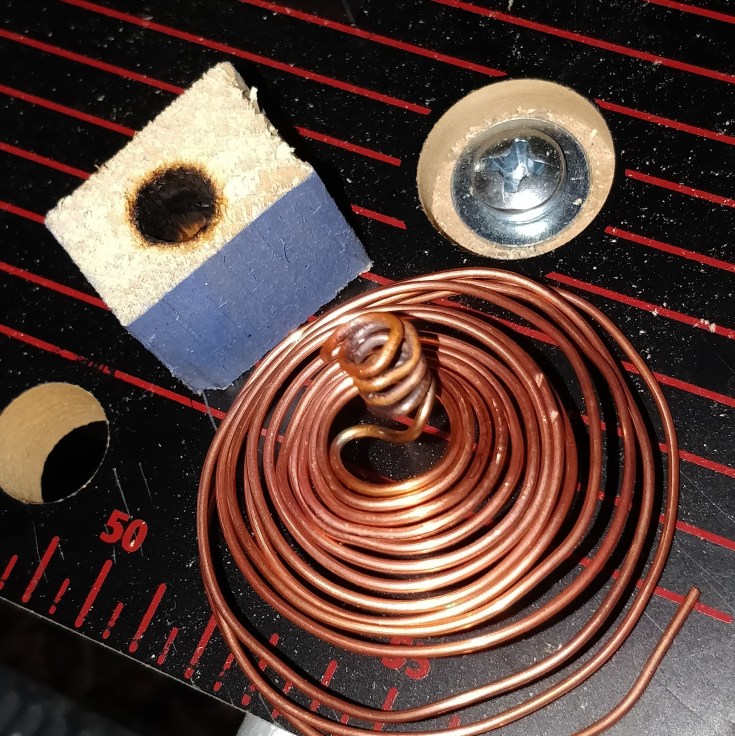
One such little black box, the slick looking patches are where the pixie smoke escaped from. Look forward to reading about this failure in a future post.


Having put this particular large wooden box together myself I was frustratingly aware of the fact that this smoke signal for failure I was accidentally sending out was not in fact a cloud with mystical properties, rather, it was the result of insulating a heater capable of reaching 300°C with wood. Wood, as luck would have it, generally catches fire at around 300°C. The more you know.

The heater was in the copper spring type part, which was in the wooden block. More wood was used to insulate the bottom of the spiralled copper but it escaped unharmed. Clearly the wooden block pictured though has indeed been very much on fire.


So, frighteningly aware of the fact that this smoke meant I had started a fire, I turned the heater off. Smart move. Smoke and burning persisted though. As you probably know, fire needs two things to burn – fuel and air (oxygen). It was only the inside of the wooden block which was in contact with the heater, so only that part was on fire at this early stage and the snugness of the fit meant that air flow to the embryonic blaze was pretty limited – even though it was surrounded by wooden fuel on all sides; ironically, it was this abundance of fuel that was preventing it from burning by limiting its access to oxygen. Had I Let It Be, it would have suffocated fairly quickly and died off. I didn’t, so it didn’t. Instead I decided to give it CPR, but, in my defence, you blow on a candle to put it out and I’m not sure I’ve ever had to fight a fire in any other situation. So, when I saw this small flame with ambitions of cooking all the food in my freezer (and the freezer too), I instinctively blew on it. It, in turn, instinctively flared up in exultation as it could finally take the breath it had been gasping for since its inception. I decided not to do that again. My second smart move of the day. Instead I watched the fire slowly suffocate and armed myself with a wet sock to finish the job if required, like some kind of sadist. The smoke brought a tear to my eye, but the death of the fire brought a smile to my face – nervous and disconcerted as it was.


Sometimes people that know CPR, that know mouth to mouth, just like me, should keep to themselves.


I did another very quick and cautious test with no wood around the heater and saw it glow red hot almost immediately, which I didn’t like. The problem is that I thought the heat could just go immediately from heater to copper tubing to cup to water. In reality there’s a lot of lagging at every stage and what I need, apparently, is something with enough “thermal mass” to capture and hold the heat from the heater until the cup is ready to accept it. Basically, I need a bigger block of metal as a hot plate and more of it should probably be in contact with the heater too.


I have spent a few days now trying to get copper blocks or aluminium blocks with the exact right dimensions, but they just don’t seem to be available. After hours of sickening myself looking for the perfect block to use I had a moment of weakness, I saw a block of steel that was roughly right and bought it immediately. Immediately after that I realised it was the wrong size entirely and now, even more sickened, I’ve bought a slightly larger one that is actually about right. The problem, though, is that it’s a large block of steel and I haven’t done nearly the amount of research I should have into whether it will be up to the challenge in order to justify buying it. But that’s a problem for when it arrives.


The reason such blocks of steel exist is actually for use as tiny anvils which jewellers use as a work surface as they hammer bits into shape. Some, like what I’ve bought, are just blocks but others are stylised as actual anvils and would make a pretty cool paperweight. But honestly, what even is a paperweight? If you want a desk toy because it looks cool buy a desk toy because it looks cool, not everything has to have a purpose outside of looking cool.

Case and point: Spoilers on your road car. They might never have to actually affect air flow or fulfil any other purpose but they don’t have to. Because they’re just so good at DEFINITELY looking cool, and hey, making you look cool while they’re at it. What an incredibly cool looking thing.

“Utah! Get me two!”

TL;DR: Rounding out the parts list; stripboard to solder everything onto, switches for safety features and controlling the lamp, a capacitive sensor to wake the clock screen and MOSFETs to control the currents that the Arduino can’t directly. Electricity is dangerous.

This isn’t the most universally entertaining post, it’s quite technical. The next post will be more creative talking about the blog itself and going momentarily off the narrative of building the clock. For this post there’s levity injected where possible but that’s not so regular, as you can assume by this disclaimer: I don’t recommend trying this project. This is not an instruction manual or reference material for electrical work, I am a very inexperienced engineer writing (believe it or not) with the intention of being entertaining, at least to myself. Assume everything I write – especially about health and safety – to be completely subjective and even more-so completely incomplete. For example, I conclude 12V is probably harmless; that means 12V DC, through my skin, while dry, at room temperature and for less than a few seconds. All of that is far too mundane to include in a blog that is already fighting against by abilities as a writer (or lack thereof) to be entertaining. Stay alive.
For the uninitiated, the footnote* (foot-essay) might be worth reading first – only the first bit about why wires might get hot though.

The basic parts list is now done; cartridge heater, LEDs, copper wire, clock, LCD. However, there’s a few more bits to add, mostly as a result of working with the fairly substantial 60W power supply. Given the supply provides 12V, my highly resistive skin should provide me with all the protection I need to avoid electricity induced burns or muscle contractions. While my skin is highly resistive, all sorts of things effect that, wet skin that has had a potential difference held across it for a long time (e.g. if I’ve just come back from the bathroom and am absent-mindedly holding wires while I try to regain my bearings) can start to accept a lot more current than it ought to. Essentially, electricity preys on fear; every bead of sweat that coats your hand makes it easier for the energy in one wire to make its way to the other by forming a path of destruction through your skin, nerves and muscles. Every second you hesitate, it breaks down your skins defences, bending your body to its will until your natural defences are overcome. Electricity pursues its mission to go from high potential to low potential with the type of tenacity and ruthlessness that extreme capitalist culture encourages people with a lack of empathy to pursue the opposite path – from low to high potential. As far as electricity is concerned the only difference between a path and a roadblock is time.

Lightning isn’t so much just a matter of time as the potential difference between the clouds and ground is actually getting higher. However, if there was a somehow lightning bolt shaped path of especially humid air, it’s definitely more likely to see a strike, similar to wet hands – more water means lower resistance (in these cases). Pretty similar concept to when things short circuit if you spill water on them too. Photo by luiisrtz on Pexels.com


Still, substantial current through me is unlikely, but if I drop a screwdriver which lands on some wires, current might flow through it and it can quite quickly get hot enough to burn me as I try to pick it up, then I’ll recoil as if in fear of this possessed screwdriver pursuing a further attack. It’s that recoiling that can lead to me hitting my head on the table or slamming my hand on a drill bit or something hot. I know that sounds like the conjecture of an overprotective mother but you learn very quickly working with electricity that these fears are well-founded.
The tidiest workshops you’ll see are those concerned with electrical equipment, the electricity supply in such workshops (not in your house or garage) is fairly safe with so much in the way of safety switches and fuses but it will still shock you. Its your knee jerk reaction that’s dangerous – a quickly retracted arm is a prime target for the exposed blade left lying around after stripping wires. Or perhaps a flailing leg is the mechanism by which the acid, imprisoned in a testing jar against its will for too long, makes good its escape. These risks are very real and make one appreciate a tidy workspace. It is wise, then, for me to keep track of where things are and where they should be, but also to buy a few switches, allowing me to turn the supply off without unplugging it every time and, more importantly, without being close to the plug. I’ll just need to make sure I know very well which side of the switch I’m working on at all times.
The switches will also find use in the end product, one to allow me to turn the light on and off like a normal lamp. Another as a sort of disconnector for the heating system as the heater says it’s comfortable operating at 350 degrees Celsius. That’s fine for the heater but everything around it, including me, would be very uncomfortable if it got anywhere near that. So I’ll need a kill switch to keep it in line in case the innate pyromaniacal tendencies ever take over. My main concern is the brains of the operation, the Arduino, coercing the heater into some sort of suicide pact while I’m not around, or teasing it, saying “I bet you can’t really get that hot”. So to prevent this I’ll put the heater into isolation from the rest of the circuit by flicking a switch as I pick up my morning cuppa and reconnect it when I set a new cup on at night. I agree; isolating the innocent, naïve party is the wrong approach entirely, the heater would never turn itself on if left unprovoked by the Arduino – the bad influence should be the one that suffers social isolation all day. Unfortunately though, reprimanding the Arduino will only lead to the rest of the students – I mean components – acting out. It’s the coward’s way out for sure but thankfully the heater doesn’t have the mental capacity to be instilled with trauma from this dreadful mistreatment. A mistreatment which only serves to accommodate the obviously emotionally incompetent and lazy teachers – I mean technically incompetent and lazy me – who can’t be bothered to work out an alternative. This of course wouldn’t be a bothersome thing to work out for a more competent engineer. So the real root of the problem clearly lies in the training processes completed by the people charged with the care of these children – I mean person charged with making this clock.
If I was to detail the problem more literally – the Arduino might turn the heater on due to a bug in my code or an unplanned clock reset. If there’s no cup to heat, there’s no telling where that enormous amount of heat energy will get redirected to – my fingers, though, trembling with trepidation almost to the point of forgetting they’ve got a job to do in typing right now, seem to think that they’re a prime target for getting cooked.

I’ll use a stripboard to link all components together – not much to say about that, it’s just a lot of strips of copper on a board that I can solder things to, making a circuit. They come with good current ratings so I can avoid anything getting hot.

Switches are fine for most things but to wake the LCD screen and request it to display the time, I think a touch sensitive button would be pretty sleek. I have an old phone which pretty much every part of has perished and figured the onboard fingerprint sensor could do the job, so I set about taking the phone apart, brutally ripping off its already busted screen and leaving my bedroom floor looking like the 33rd floor of Nakatomi Plaza in the process. Heartbreakingly, the sensor had special connections that I couldn’t make use of. Which I most certainly could have just found out using Google.
Thankfully touch sensors are fairly easy to make from pretty much any sheet of metal and a resistor. One of the heat sinks in the phone is a perfectly sized sheet of copper to make a button out of, so the John McClane cosplay wasn’t completely in vain.

A touch sensor (the blue wire and everything to the right of it). Quickly prototyped on a breadboard using a steel soldering iron rest as the “button”. The bigger the metal sheet used, the more sensitive the button is – in this case I could just hover my hand near it and still be sensed.

Lastly but probably most importantly, we need to return to that whole Arduino being a bit of a manipulative bully analogy from earlier to understand why I need MOSFETs – that’s an acronym, I’m not just super excited to talk about these special transistors, I am a little excited, though. During uni I’ve looked into pretty much every analogy to try and understand a transistor’s inner workings; the interesting ones don’t explain it well and the ones that explain it well aren’t interesting, so I’ll spare you any attempt at describing it. The outer workings are pretty intuitive though – basically, the heater draws just over 4 Amps while (hopefully) boiling water, but the Arduino is unwilling to give it any more than about a tenth of that for fear of morphing into a heater itself and everything getting a bit melty (noticing a theme?*). To get around this, the Arduino can delegate the supply of current to the heater to a MOSFET, which is more than capable of commanding 4 Amps, but not without explicit commands to do so. Whereas before the Arduino would have had to push with everything it had and more to get the heater to even think about doing its job, it can now simply wave its hand to the newly appointed and very obliging enforcer which will wrangle the heater into compliance. MOSFETs, and all transistors, are basically switches that machines can control. So the heater will have its own direct line to every bit of power that the Arduino has access to but the MOSFET controls whether that line is in use or not, and the Arduino decides what the MOSFET decides, and I decide what the Arduino decides, and . . .
I also think I’ll use a MOSFET to control the LED, it’s not really necessary here – I could wire it differently but incorporating the switch that allows the use of the LED as a regular lamp outside of sunrise hours gets slightly more involved and MOSFETs come in packs of 10 anyway. Pretty much everything I’ve mentioned on this shopping list has had to be bought in a pack of at least two which should be great for experimenting.
Other than that, a few wires, a roll of tape and some solder will be needed but as best as I can make out the shopping list is complete for now!
I’m not sure if I’ll actually write about this but I’ll also buy a few smaller LEDs and a breadboard which can be great for verifying the code works without getting a 12V supply and 50W heater involved.

A simple circuit using a MOSFET – the silver thing with a hole in it. All this circuit did was turn the bulb on and off. The silver holed part is actually just a heat sink, the magic happens in the black casing,. The fact that these come with a means to get rid of heat quickly should confirm that these little things can wield some serious power.


* A note on electricity and heat: People often think live wires are thermally hot – they shouldn’t be. The wire getting hot means it is giving off power as heat – where is it getting that power? It’s stealing from the power you have tasked it with carrying to your phone’s battery.
If a wire has a limited number of electrons, (the particles tasked with carrying electrical current) attempting to transfer large currents means the electrons are overworked and start making mistakes, bumping into each other and generally getting all hot and bothered. The more this happens the more they hit each other and the more temper(ature)s flare. So it’s very important to ensure your wire has enough electrons to carry the current you’re trying to send through it, otherwise they’ll waste so much of it bumping into one another that the majority of your power has been given off as heat before it gets the chance to reach whatever you were trying to power. Thankfully the solution is simple, just employ more electrons – use a thicker wire, split the current between two wires or use a better conductor (with more free electrons per unit volume). There’s other ways too.
The wires in the Arduino can carry 2 Amps without getting hot, above this they heat up and start melting the plastic board they’re embedded in.

I suspect no-one will be reading at this point – I’m about to tackle why touching live wires burns, even if the wire itself isn’t (thermally) hot – “hot” can also mean live when dealing with electricity. Honestly it’s only worth reading if you’re really interested, I’m mainly writing to improve my own understanding of it, I’ll still try to make it readable but it will be devoid of figurative language. Again – this is incomplete and quite possibly inaccurate!!
If you put current through something resistive it will dissipate heat power to the tune of I2R; the current through it squared, multiplied by its resistance. Clearly if you’re using a high current then you need a very low resistance to avoid too much heat being dissipated. Also, voltage is equal to the current multiplied by resistance (V=IR for the acquainted). Voltage is the thing to watch out for primarily – also called potential difference as it represents the electrical potential between two points. A 12V DC supply like I’m using will have 12V of electrical potential between the red and black wires, if I were to grab both with one hand and my skin had resistance of 100,000 ohms, the current would be 0.00012 Amps through my skin. So referring back to the previous formula, 0.000122 x 100,000 = 0.00144 Watts of heat is dissipated by my hand – that’s just over the power my Wi-Fi router antenna emits – and I can hold that all day without getting warm. The FCC makes sure of that.
At higher voltages the heat dissipated by my hand will increase, the wire isn’t getting hot, I am. The maths for working out where real burning would occur is maybe a little beyond me and honestly pretty pointless since there is always the danger of something other than my hand coming between both wires and getting hotter than my hand would, coupled with the danger of me touching that something. Also, at a certain point, skin starts to get broken down because of electrical potential across it, causing its resistance to drop and allowing more current to flow – trying to factor this in is pretty much pointless as there are too many variables that will change every time you work – “have I showered yet today?” and “what did I have for lunch?”
Also important is that long before burning actually occurs, other dangers will get to me, our brain communicates using minute electrical signals and so our pain receptors are fantastic at detecting electrical current, so while I may not be burning, I will be feeling tremendous amounts of pain. Muscles also begin to be overwhelmed by electrical signals and start convulsing, particularly troublesome around the lungs and heart. Although, humans being the fantastic race we are have developed life-saving defibrillators based on this principal to kickstart the heart with a big current induced contraction.
Also also important is that mains supply and a huge amount of what you are likely to encounter is AC, not DC, which is something I shan’t go into except to say that AC doesn’t find your skin’s resistance to be so much of an issue.
Electricity is very dangerous. Taking advice from strangers on the internet is very dangerous. Inferring advice from an entertainment-driven blog is very dangerous. Inferring electricity-related advice from a stranger’s entertainment-driven blog on the internet is very very very dangerous.

Mastering Entropy

TL;DR: I’m using a relatively low powered cartridge heater to heat the water so that it can use the same power supply as the Arduino. For aesthetics it will be inserted into a sort of electric hob style spiral set up made from copper.

I said previously that some part of my brain had sketched a parts list for this project, however, now that I sit down to materialise that into an order form, it is becoming clear that it skimped on the details. It’s becoming increasingly apparent that a heater, a light and an Uno board does not constitute a parts list for this project. Finding a suitable heater is tricky, thankfully, as I mentioned in my last post, I’m interested in 3D printers.
There was a mild interest before with my uninspired Arduino build but this year at uni I had the pleasure of working to prototype some sensors and anytime something I needed didn’t exist I would just go home, design it and send it to the technician, the next day it would be sitting in a bag with my name on it. Completely bespoke, a perfect solution. Or at least perfect within the confines of my designing capabilities. I defy anyone to not be completely spellbound by 3D printers after having used them to do something genuinely useful. Imagine a world without compromise – if something is too big or too soft or too red, you can just tell this machine to make you a smaller, harder, bluer version. And it will . . . Madness. This obsession will no doubt lead me to buy one and Amazon is keen to be in on the action. I’ll go shopping for a first aid kit and the screen will contain the absolute minimum amount of medical supplies that it knows I’ll tolerate, the rest being a mosaic tile arrangement of: 3D printer parts at low low prices; stylish coffee makers crafted from exotic looking wood and shiny metal; and books that promise they’ll help me get my life together. Amazon really does know me, and now, so do you.
Thankfully one of these printer parts is the heater used to melt the printing material, which I think looks about perfect for heating a single cup of water.

Cartridge Heater
A 3D printer’s cartridge heater

Simply dipping it into the cup as an immersion heater would never suffice though, far too inelegant. Plus, as any Irish person will know, there is a horrible stigma around the use of an immersion heater – the cause of many’s a family argument:
“Who turned the immersion heater on/off?!!”
“The water from the central heating is plenty warm!”
“The shower ran Baltic after 5 minutes, I’ve near caught pneumonia!”
“Our electric bill is sky high because of that thing”
“Tell *insert family member* to quit using their xbox/laptop/electric heater all day if you’re worried about electric, I need a shower!”
Clearly an immersion approach won’t work. I think I could rig the heater up to a hot plate and use an enamel camping mug pretty easily though. I’ll use a copper wire to form a spiral that dips out at the centre to wrap around the heater. Copper also has the benefit of being very nice to look at.
I don’t think I explained it very well at all so here’s a photo:

Copper Wire
An Imperfect version of the copper hot plate – spiralled plate with a small spiral in the middle where the heater snugly fits

The big question is will it work? The heater I want has to be small and take a 12V supply, this limits power to about a 50W, or, 3% of a typical kettle. I could have a heater similar to a kettle but it would require a separate power source as the Uno board (brains of the operation) can only accept a maximum of 12V. So, it’s either cap the heater at 12V too or provide it with power from somewhere else. If an immersion heater approach is inelegant, having two different power supplies wired into the clock is abhorrent.


I’ve done the maths around it a few times and it checks out that a 50W kettle would nearly boil a cup of water in about 20 minutes, which is fine as I’ll be asleep anyway. The problem is, this isn’t a kettle – it’s basically a hob and saucepan, which the internet slates as about 50% less efficient. I’m optimistic though, comparisons on efficiency are difficult to make, especially when I’m building this hob myself and can tweak it to make it more kettle-like. One solution I suppose is to put an insulating sleeve and lid on the cup to ensure it retains all the heat it is given, however, the inclusion of a plastic cup-cover is going to make designing this thing to look as good as it has a right to be (it is a bespoke, hand-built alarm clock after all), considerably more difficult.
For now I know I want a cartridge heater from a 3D printer, some copper tubing (the type used for refrigerant systems) and a 12V power adapter with enough juice to power the 50W heater and an Arduino Uno. I definitely don’t want the heater robbing the board of power.
This is where the mothers lifting cars to save children legend becomes germane, the brain has told the muscles to try and save the child, knowing if things get out of hand it can always take the reigns again and ensure its own preservation returns to being number one priority. It has forgotten, however, that it shares a blood supply with the same muscles it has commanded to perform a very bloodthirsty task. The muscles begin, politely, with their usual allowance of the body’s blood supply but that doesn’t cut it, so they start robbing blood from every other organ in the body, including the brain. The brain is now left with no blood to fuel it. It might very well want to slam the brakes and say hey, we’re in major trouble here, forget about the child, I need that blood to keep us safe. However, without the energy it’s being robbed of it can’t scream its message loud enough to overcome the bedlam besieging the muscles as blood floods into them from all directions. The whole process leaves the muscles torn apart and a brain that has known true anarchy for the first time, now unsure how willing the body will be to return to the dictatorial regime which up to now there had been no alternative to.
In a much less interesting way, if the Arduino turns on the heater which takes 50W from a 50W supply, that leaves nothing for the Arduino, so it can’t send the stop signal until the heater has reached temperatures where it melts its connection to the power supply, at which point there will most certainly be a smouldering puddle of plastic releasing every carcinogen under the rainbow on my bedside cabinet.
All of that isn’t completely true, the heater and Uno have a slightly more democratic way of splitting the power but there’s definitely the risk of a necessary stop command not being sent if the supply is overloaded.
A 60W supply should be fine.


Hussle and Motivate

TL;DR: I have an Arduino Uno from an abandoned project that I want to find a use for, a cup of tea being made will all but guarantee I get out of bed in the morning as opposed to checking my phone. A sunrise lamp is a good feature.

A couple of years ago I bought an Osoyoo (knock-off Arduino) Uno CNC plotter kit with the best intentions of building a CNC plotter from scratch, maybe even fitting it with a hot point to make a CNC wood engraver / house fire starter or a “3D printer pen” in a bid to be able to say I made my own 3D printer.

“I, Caleb Halfpenny, have made the thing which can make all things.”

Or words to that effect. In reality, knowing what I now know about the technology, if a competition broke out between myself with my “3D printer” and a toddler, armed with some Play-Doh, I’d just have to hope the child becomes as distracted by the smell of the clay as I always did. I like to picture the intuition that these projects were ill-conceived and destined to disappoint as a tennis player in my brain. A perfect tennis player guarding my physical response receptors, swatting away the neurons obsessed with this silliness before they get the chance to manifest into the actions that would absolutely and undoubtedly lead me to either burn my house down or be embarrassed by a toddler.
In reality though that intuition wasn’t there at all, those tennis ball neurons never even made it over the net as their server limply set them into motion, holding his racket with the grip of a teenage boy holding his younger brother’s hand to cross the road. The feeling of wanting to keep his kin safe and the overbearing teenage fear of being ridiculed causing the emotional scale to net out somewhere around apathy, but it’s an overwhelming apathy, closer to an anxious, confused impasse than real carelessness. The two sides of the internal tug-of-war are pulling with everything they have but neither can gain an inch, all their efforts merely increase the tension in the centre of the rope.
I wanted to pursue that project so that I could advertise it as some engineering feat I had accomplished independently, which would be great for a quirky interview answer – something I valued very highly then while desperately searching for a placement role. I didn’t want to pursue the project because it would take up a lot of placement application time and I didn’t really have a use for a CNC plotter.
So, I resolved not to build the machine, but the tension in that rope didn’t release, it remained as potential energy; untapped potential energy. Since then the unused Uno board has been as present in the back of my mind as it has been in the top of my wardrobe and I’ve always been keen to finally put it to use.

(Unused) CNC Shields for Arduino Uno

Now, today, I think I’ve found the use for that board. It’s been brewing for a while now; I want an alarm clock to ensure my phone isn’t the first thing I look at every morning and as I considered alarms I grew attracted to the concept of a simulated sunrise and that of tea/coffee preparation. But today the notion hit me that I could make those myself. “Sounds like a nice project” I thought, and went about my business. Somewhere inside though an obsession had began. I realised this myself the next time I went to check in on the idea and some part of my brain had stuck a post-it note to it with a parts list and rough design. Now we’re moving.
The power of having a good morning routine is preached about everywhere and at university it is evident. At university you live on your own terms mostly, if you don’t feel like getting out of bed, there’s no immediate repercussions forcing you against your will. Most days I wake up and go by 9 a.m. at the latest to either attend uni or get to the gym outside of peak hours, this is usually good enough motivation. The weekends though, where I give my body and mind a break are where troublesome habits become clear. I think letting my phone dictate when I get out of bed is a mistake. Using the alarm on it is convenient but it ensures the first thing in my hand every day is also capable of holding my attention for the entire day, and it certainly doesn’t encourage getting out of bed. On a day of low motivation I should be able to rely on my alarm clock to give me a reason to get out of bed. Sometimes the phone does this – a calendar reminder or a text from a friend wanting to go for breakfast, but more normally the phone does the opposite. I can interface with the entire world and live my life through it without getting out of bed and so I probably will, at least until I get hungry or need the bathroom. While I can live life through my phone, I prefer not to, I prefer to get up, enjoy a cup of tea with breakfast and do something a bit more involved like go for a walk at least. The phone has one key advantage in the morning routine though that allows it to win out most of the time – it’s already got my attention. And it sure knows how to keep it. YouTube knows how much I enjoy watching the sun rise so it has to have a bright red icon to catch my attention first. Facebook knows how much I enjoy a good breakfast so it has to bombard me with memes to distract me from my mild hunger. Instagram knows I’d love to get up and be active so it shows me only the prettiest of people, in automatically playing videos and captures my attention before even my own body has a chance to let me know it’s getting restless.
This is for the most part a passive experience though, I don’t actively engage in or even enjoy the morning routine, it’s like talking about the weather – inoffensive and could lead to something better – learning there’s a heatwave on the way, or seeing a post from a friend that shows them having fun. I’ve never went to bed at night excited at the prospect of checking my phone in the morning, or set my alarm for earlier than normal so I can enjoy the first posts of the day in real-time. So I need a wake up call that I can engage with actively, that encourages me to get out of bed, and boiling a cup of water is absolutely perfect for a few reasons:

  1. Starting obvious, a cup of tea has caffeine, which of course takes it’s name from café, which is where a French maid would work. Caffeine being the French maid that walks around behind your eyes dusting off cobwebs when you drink a caffeinated beverage.
  2. I enjoy tea actively rather than passively. One of my favourite things is to bring hot tea to my face and blow on it, basking in the fragrant steam that rises over my face and rejuvenates my eyes. My eyes which I have so cruelly exposed to this harshly arid world again, after a full 8 hours of tranquil bathing under their lids. They get it the worst in the morning, immediately they dry out and so the lids get shut again to spare the pain but they’re already so dry that the lids feel coarse as they close – that didn’t feel right, try again – same result, the pain is too much – I cry slightly, moistening the eyes and hence readying them for another day in this hostile world. This is of course the reason humans cry as a natural reaction to pain, so that the pain of dry eyes in the morning can be alleviated without the brain having to be fully awake.
    I also just enjoy drinking tea, you know, like a normal person.
  3. I, for one, can’t drink lying down. At the least I’ll have to sit up in bed to avoid waterboarding myself with scalding tea. My chest now being exposed from the duvet is good priming for taking that next leap out of bed.
  4. This is the most important point of all, all the others rely on me drinking the tea, what’s to stop me just lying on and boiling the kettle later? Well, I am. If there’s one thing I’ll credit myself for it’s not being wasteful. If that water is boiled it’s being used. I’ll do everything in my power to only use one pot when cooking, to the point where it has to be driven by a desire for efficiency rather than just laziness. Old jeans are now garden-work jeans, T-shirts, pyjama tops. I’ll use books I don’t like as work surfaces (my copy of Camus’ “The Myth of Sisyphus” was cut to shreds while used as a cutting board. Imagine finding a book about why life is worth living shredded with a scalpel on someone’s bedside cabinet, like some sort of violent protest to the concept that life has meaning. I’d be worried. I didn’t disagree entirely with the book, I just found the way it was written to be absolutely impenetrable – of course life has meaning. Doesn’t it?). So the thought of letting all the energy put into heating that water go to waste is . . . absurd.
A model illustrating point 2 in a much more photogenic way than I could myself. By Andrea Piacquadio on Pexels.com

That’s the motivation then, I want an alarm clock that inspires me to get out of bed, so it should make tea. A gradual illumination of the room is apparently the preferred wake up call for the ancient parts of the human body, which I have to assume are the only ones that matter when I’m sleeping, so that will be a nice feature to add. I have the brains of the operation in an Uno board and the ability to program it myself so I’ll just buy some lights and a heater, the thing will practically build itself. I can swap out the cheap looking white plastic housing these sunrise alarm clocks typically use for whatever I please. It’s going to be a great little project to work on and I’ll use the end product every single day. Fantastic!

Create a website or blog at WordPress.com

Up ↑