

Story So Far: A lamp has been made, a hot plate has been made, some buttons have been made or bought, a clock and an LCD screen have been bought. All has been wired up and programmed. Just need to give it all somewhere to call home.
TL;DR: First and last two paragraphs are on the project/blog, just saying what casing situation is. Everything in between is beyond the realm of tangential and well into just plain irrelevant – why acupuncture works and why smells make for more potently emotional memories than other senses can come up with.
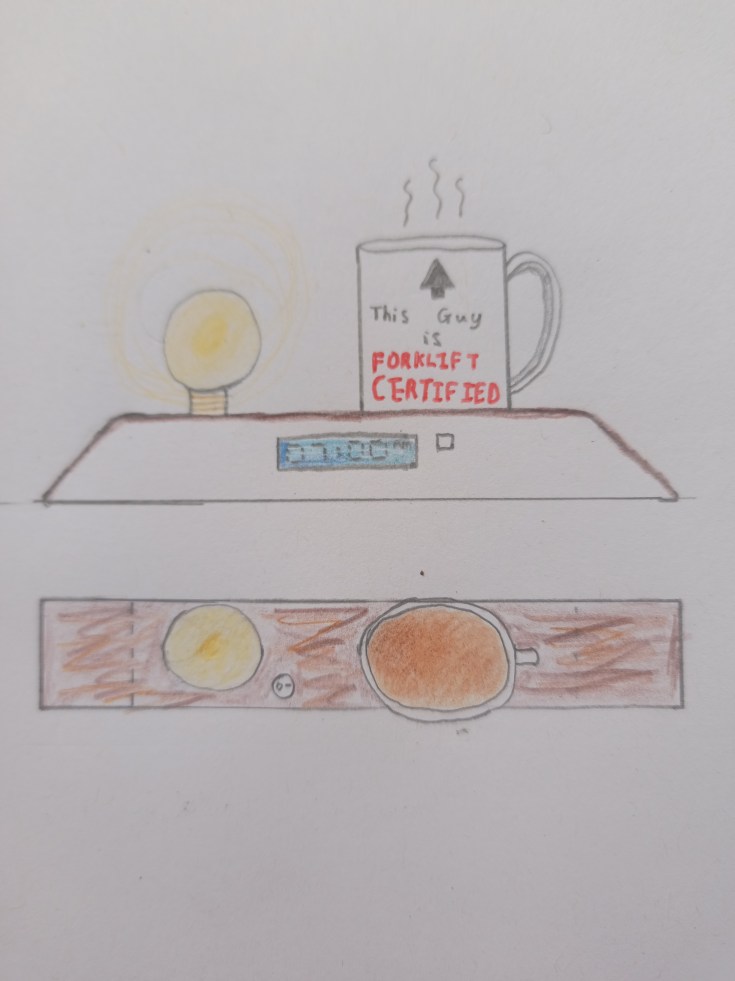
As I’ve mentioned somewhere before, this is a completely hand-built, bespoke alarm clock and has a right to be aestheticised accordingly. The proposed design is below; glossy white plastic casing and a wooden veneer finish on the top panel. Unfortunately, to make that happen I need two things; the means to make those panels out of glossy white plastic, and the motivation to make an accurate sketch in CAD. Both of these things are beyond the horizon as I look through time from the present moment. Oh well.
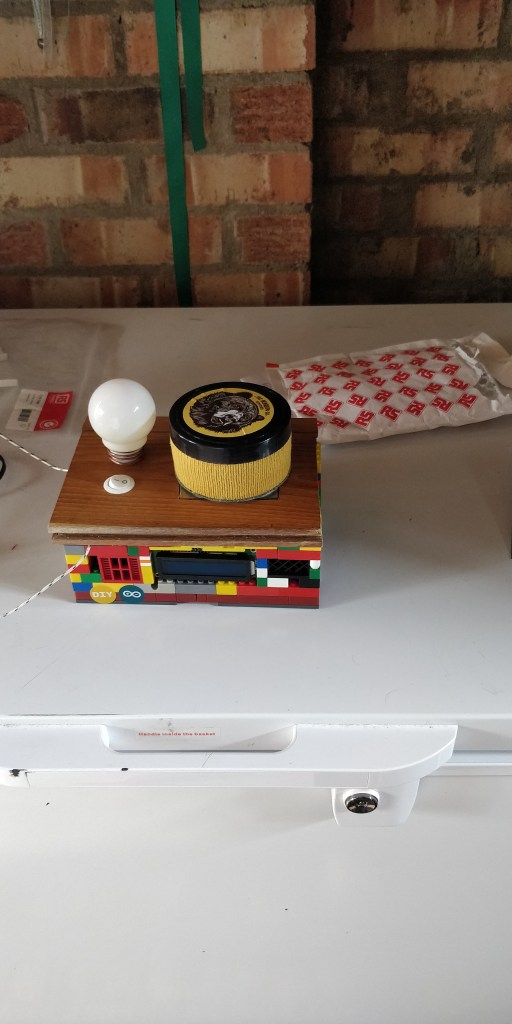
In the meantime, there’s a pretty easy cop out. A base and four walls made from LEGO with a top panel made from an old floorboard. I like to think it makes up for being utterly tasteless as a piece of homeware by being a tasteful homage to the life-long engineering pilgrimage that has culminated in its creation – there’s something flirting with profoundness in the fact that the first project I’ve done as a qualified engineer is made from the toy that very probably predestined the entire journey. I think that whether the clock, in its temporary form, appears as flamboyant or garish really just depends on how camp the entire project is, on its ability to present itself immediately and unmistakeably as only having been created in the context of itself and the joy it might bring. Given that every post so far involves some sort of technical hiccup and a subsequent compromise, I’m not brimming with confidence that I have achieved good camp; it’s difficult to say exactly what camp is, but it certainly isn’t compromise1. It also isn’t a goal to be achieved and anyone who has ever made it so has failed before they start.

So, what hope do I have of having made something good here? Well, one place there has been no compromise has been these blog posts – self-indulgent and conceited, almost to an onanistic extent, with very little irony. Perhaps then, the project as a whole can be construed as camp, and thus, the clock’s physical form construed as intriguingly vulgar, rather than nauseating and garish. Probably not though. And in any case, my opinion on the matter is the least important of all. Regardless, the Teamaster 2000 blog series is ending with this post, only to be appended to if/when I feel like it. It’s been a good run but, as I have had other ideas, I have developed cabin fever with this project as a framework for my writing. There’ll be a rearrangement of the entire site soon to accommodate different subject matters. For right now though, here’s some unabashed nonsense. Enjoy.
Like for like, if you compare an adequately caffeinated human with a horse, it would be accurate, if a little unkind, to call the horse an idiot. One thing that humans and horses can both recognise though, is that the sensation of the individual sinews in your leg muscles morphing into wound-steel guitar strings that scour one another with each muscle contraction is a sensation that’s probably best avoided. Primarily because it hurts, but also because it probably means that you’re about to shred those strings. In a bad way. But, with modern medicine’s miraculous mastering of human physiotherapy and horse euthanasia, is the risk of catastrophic fissuring worth it? Picture the scene; you’re a delusional jockey. You know your horse is the fastest, you know it can bring home the win, you’re just worried that it might suddenly become aware of the fact that it is tearing itself limb from limb in the process and that that moment of hesitancy before you can whip some sense into the dumb thing will cost you everything. What can you do to prevent this travesty? Well, you could rub your horse with chili peppers. As luck would have it, horses can only feel one of either; a dull, persistent pain (muscle pain, mild headaches, crushing etc); or a sharp, momentary pain (burning, stabbing etc) at any one time. The preference, for survival reasons, goes to the sharp, momentary pain (we can afford to forget about dull aches for the duration of a short sharp pain, but not being able to feel short sharp pains in a place where you have a chronic dull ache might mean you don’t feel it when you get stabbed, or bitten by an insect). So, what’s that got to do with chili peppers? Capsaicin, the “hot” chemical in peppers, is perceived as hot because its chemical structure allows it to bind with the receptors we use to know if things are (thermally) hot. These same receptors trigger an almost identical response to that associated with physical pain and the neural pathways which light up because of heat tend to be of the variety that represents sharp, momentary pain – the same variety which overrides (in a sense, provides relief from) dull aches. So, hear me out; we rub this Stupid Horse up and down with chilis, emulating its immolation, the pain prevents the animal from noticing that it is utterly eviscerating its own muscles, it runs like a creature possessed and ruptures every fibre of its being in doing so, the capsaicin loses its potency, a muscular cataclysm surges through the beast, the on-site vet tells you how much a horse’s lifetime of ketamine costs, the prize money won’t cover it, horsey gets trolleyed to the Temple Grandin temple and they drive a bolt into its head, that night you drink from the winner’s cup and argue with a man in an alleyway about how much ketamine costs. A winner.
Hell of a proposition, and also the reason capsaicin is an illegal doping agent in equestrian sports. The whipping, which is not only legal but crucial, has a similar “numbing” effect though. This also works on humans and is the reason pre-match changing rooms for a variety of sports wreak of deep-heat, and also why acupuncture and massages make you forget about your chronic back pain2.

I say all that to say that the science behind human senses is interesting and useful. I also say it because it’s rare to be in a social situation where I get the chance to. Anyway, the sense of touch/pain is fascinating of course, but the sense at the heart of this post is smell. This peculiar sense is uniquely poised to debase our rational-thinking cortexes and annul the “sapien” status we have endowed ourselves with. By this I mean a familiar smell is much more likely to trigger fits of pique than other sensations are3. To illustrate:
Cast your mind back to the last time you lost control – convulsive laughter, apoplectic rage, hysteric crying, etc, all just variations on a theme really. The theme being that even if God had given us free will, there’s still parts of us that have literally no concept of who the fuck we are and, as such, will never bend to that will. For most people, one such part is the limbic system, the captain of our emotions. Most interactions light up our whole brain and bounce around until they finally catch the attention of the cortex, the executive part of the brain, and the part where our sense of self is strong, in this way we can interact in a manner that is “in-character” for us. Some interactions though, make a B-line for our limbic system and before we can think about how we, our grandiose idea of ourselves, feel about something and then go about releasing chemicals to feel that way, our limbic system has already put in motion the production of the euphoric, aggressive, or depressive chemicals in our body. Things like somebody slipping on a banana peel, slapping us in the face, or mentioning a loved one will often trigger this kind of unconscious response. Also, things like smells. Turns out our olfactory system is uniquely linked to our limbic system, so that no matter who we are, or who we think we are, some smells will just make us feel things. Evolutionarily, this makes a lot of sense. People/proto-people who had an innate and immediate aversion to the smell of bear urine probably had a much better survival rate than those who’s biology allowed it to come down to personal preference. Although it is hard to imagine a huge difference between the two groups.
All sorts of things trigger a strong limbic system reaction, but not all of them end up with us curled up, cowering in the corner of the kitchen trying to remember the last time I cried like this? And is it usually this harrowing? And is it happening more often? Is it starting to define me? Did I see it coming? Can I see it coming? What if someone walks in? What if someone calls? What if this happens in front of someone? Is it over? That’s it? Well, okay. Maybe I’ll have a nap.
Well, the difference between a melancholy twang and an all out fit, is how capable your cortex is to retake/steer the reigns. This of course depends on many things, but the events that are truly capable of razing that little neuron nucleation point that endows us with “humanity” to the ground, are those that attack its foundations. The cortex’s entire métier is to rationalise the world through the sensibility of our ego. This allows it to do all sorts of things, most notably, predict the future (rightly or wrongly). Anyway, assuming my immediately-and-easily-proven-to-be-incorrect™ definition of it is correct, we can see that to sabotage our cortex there are two options. We can suppress our ego, which can lead us to be free of the pains of pre-cognition and prejudice and truly live in the moment (for some this is an intentional and spiritual ascent to the pinnacle of Maslow’s Hierarchy, for others, it is a symptom of their unintentional and hellacious descent to the opposite end), or, the world around us can become entirely unrationalisable. Focusing on the latter and circling back to the sense of smell, as you are no doubt attentively waiting for me to do, the memory of a smell can be pretty difficult to contextualise, and contextualising is a pretty big part of how we rationalise the world around us. For example, seeing a familiar actor in a movie, a world where you don’t know who she is doesn’t make sense, it’s irrational, but you just can’t quite say you fully remember her. So, you contextualise the faint memory of her by going to her IMDB and seeing that she had a cameo in Friends one time. The frosted glass you were viewing the memory through clarifies. You turn off the movie that you weren’t that invested in anyway and switch to an episode of Friends you’ve seen more often than your actual friends this past year. The world makes sense again3.
We primarily perceive the world visually, and so context for memories is often synonymous with some sort of imagery. When we encounter a smell and commit it to memory, we also store an image of the source of that smell as context for it. This is then our memory of that smell. But, as time goes on and you encounter the aroma again and again, produced by different sources and in different surroundings, it becomes decontextualised in your memory. So, when you smell cheap plastic, it may remind you of a Kinder Egg, or a ball pit, or a LEGO set. If you still encounter any of those three things on a regular basis, your brain will immediately associate the smell with that item, and you can picture it. If, however, you’ve stuck to the societal norms of growing up, it’s likely some time since you last encountered any of the worthless treasures of your childhood, and a whiff of their characteristic plastic will inundate your brain with a familiar fragrance and the feeling of contentment that you haven’t experienced since you were a child at play. Your head will spin as the scent flares up a limbic system emotional response and the absolute bewilderment induced by the lack of context will only amplify the emotions, your brain has absolutely no idea which visual memory to attribute to this smell and you’re in limbic limbo until it comes up with something. Eventually, when you really try to pin it down, you will come up with a specific ghost of your past to lament over, this is not to say that the smell genuinely most resembled that item, but more to say that you were thinking about that thing, or things adjacent to it, most recently and were primed to land on it.
Put all of the above together and you’ve got a mess of a blog post. Put the bits about olfaction together and you’ve got a sense that not only takes a shortcut not available to other senses to illicit an emotional response. But also, a sense that can make sure that response lasts. Not only has your nose got a head start on your rational brain, but it’s also tied your brain’s shoelaces together.

It’s worth pointing out that there are also smells that actually do conjure up a specific image, like if you only ever smelled that weird soft-yet-abrasive carpet that has a texture somewhere between the two sides of Velcro when you were a child lying on the floor of your local library. When you’re hit with that scent anywhere else, it will likely conjure up an image of that weird blue-yet-grey carpet that is almost certainly made from old bus seats in a process that is disconcertingly similar to how pigs (presumably along with other animals) get turned into Billy Bear ham (not a sponsor). This scent may well cause an overwhelming emotional response, but this response is more akin to seeing an old friend than the previously described frantic scouring of memory banks for an image to provide context to a familiar smell.
I say all that to say that I was feeling overwhelmingly nostalgic when I used LEGO to build the casing for this alarm clock. I also say it because it’s rare to be in a social situation where I get the chance to. This post started as a commentary of my emotions and memories as I sat fulfilling a childhood fantasy; playing with LEGO by light of a head-torch, well into the night, cross-legged on the garage floor. But the narrative fell apart pretty quickly so I deleted it all and wrote the above. I’ll be honest, the entire build didn’t work out terribly well. It doesn’t look at all like I envisioned, and steel was a horrible material choice for the hot plate. The steel cuboid will one day be an aluminium (I think) cylinder, and the LEGO/floorboard housing will be superseded. That sentence might well be the full extent to which I write about those updates though. I still enjoy the thought of the build, but I’m over writing about it.
Thanks for reading. While I can’t give any timescales for anything, I can give some details on what the future content of this site will be. As you’ll have noticed, I have a penchant for biology, this will be developed on. I also intend to write short pieces inspired by other stories I’ve heard, either in books or in music or in some other form. As a special case of this I intend to make a page called “Helsabot Fanfiction”. “Fanfiction” here being very tongue-in-cheek.
1 – Please read Notes on Camp by Susan Sontag, a “paper” published in the 1960s. Very good read.
2 – I’ve got nothing against jockeys. Also racehorses are generally very well looked after and the events detailed are an exaggeration of the highest order. Horses were indeed “doped” with capsaicin so they wouldn’t feel pain, but if it would be possible for one to run so hard that it gives itself injuries that warrant being put down, I don’t believe so, but I don’t really care to look. I’m very happy to be naive on this issue.
3 – All of this stuff may be entirely wrong, at a high level and at a low level. It’s all accurate as far as I know, but I have a chronic and severe case of Dunning-Kruger-itis.

 Trysworth Curiosity Company