
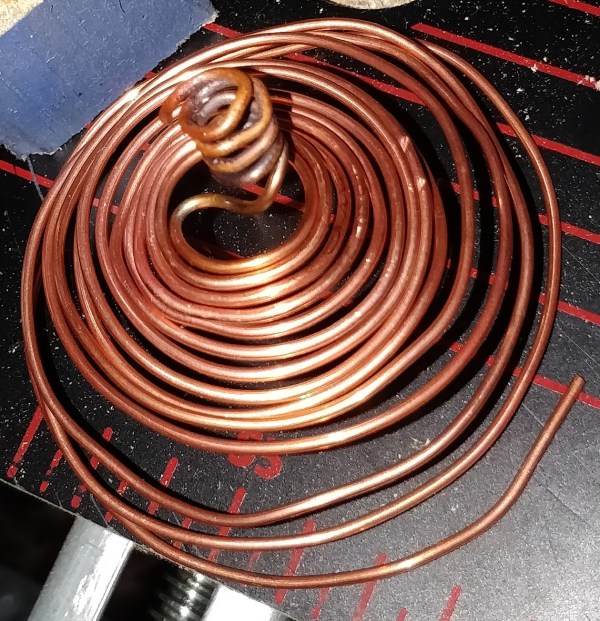
TL;DR: All parts have arrived, immersing the heater into a cup of water brought the water to temperature in about 20 minutes. A hot plate has been fashioned for test 2.
I ensured all the parts for the clock were due to arrive on the same day, that way I avoid any risk of losing motivation. Right now, they’re scattered unceremoniously on my unmade bed but everything seems to be in order. First priority is to transfer everything to a well partitioned box so it’s all easy to find. Now that’s done, what to test first? There’s only one answer here – the heater. All my maths indicated a 50W heater could take as little as 20 minutes to boil a cup of water. Now, here’s the issue – pick any noun in that last sentence, got one? Prefix it with imperfect. My maths is just lazy and the cheap cartridge heater probably isn’t actually 50W output. The cup isn’t a fantastic insulator so it will let heat escape and the water within the cup won’t always start at 23°C. I think that’s call for some real-world tests.
The first test is going to be the heater connected to the power supply (through a switch for control) and the hot end dropped into a cup of water, immersion heater style. This is just to prove the heater can indeed heat water in the real world. Enjoy the following contrived analogy for the practical inaccuracies suffered at the expense of operating in the real world:
Cast in order of appearance:
Robin Hood – The cup
The Rich – The water within the cup
The Poor – The air around the cup
Maid Marian – Entropy
The cup will act like the Robin Hood of robbing heat. The cup itself has no desire for heat, in fact, it would quite gladly go through life at room temperature with its mind on other things. The water within the cup, conversely, has made its life’s goal to accrue as much heat as possible. Looking around in any direction all the water can see is the ever-ruminant cup. The water can only assume then that the rest of the world does not value heat so dearly, those without heat can get by with the same lofty attitude this cup has adopted. So, the water retains vast amounts of heat for itself, obscene amounts to you and I. Obscene amounts as the air around the cup would view it too. This surrounding air laments over what it could do with just one morsel of heat, perhaps it could rise and escape its cold and desolate dwelling.

The cup can see the vast amounts of heat possessed by the water, the cup can also see the air crying out for any touch of heat, finally, the cup can see the disparity between the two sides – so the cup can see injustice? Possibly. But the Robin Hood of this story is so blinded by his own apathy towards heat that he does nothing to even the playing field. He is unsure how to proceed – he could steal from the rich (heat rich) and bestow upon the poor, or, he could teach the poor how to live like him and be content in their cold slums. He spends his time arrested by and enamoured with this vision of teaching strength despite poverty and how he could become the being that all those beneath him strive to emulate. However, he neglects to notice that for people to have to strive to be like him, they must not be like him, and thus, perhaps they do not have the capacity to ever be. Like him, that is. He fantasises nonetheless, all the while, the poor air is unable to summon the energy to let its mind wander to such frivolity; thinking about anything other than where it can source heat is a luxury. Every thought that enters the air’s mind is just a veiled cry for warmth:
“What is that?” read “Is that a heat source?”
“How are you?” read “Have you found heat?”
“What time is it?” read “How long has it been without heat? Surely some will appear soon!”
The suffering continues. The air cries for a saviour. Enter, Maid Marian, our character to represent entropy.
Entropy is sickened at the thought of the existence of such disparity between the haves and the have-nots, but entropy is far above exacting equity herself. If she were to be preoccupied with actually resolving every injustice there was, who would call attention to the infinite injustices that arise every second? No, Maid Marian must call others to action. Maid Marian, so alluring to the lost causes that with the bat of an eyelash she can summon the breeze that knocks our Robin Hood off his well-worn perch atop the fence. Dreams of achieving idol status to the air are cast aside and replaced with fantasies of being in the company of something so perfect as entropy, even in the capacity of a servant. Immediately the cup sets to work, robbing heat from the water’s relative excess and disseminating to the air on the other side, assured by his Maid Marian that what he’s doing is justified. Truthfully, whether or not anything is justified is irrelevant to him now, the objectivity and altruism that he had mused upon while procrastinating on the fence has been replaced by one question: “What would Maid Marian do?”. If he weren’t so blinded by his infatuation, he might realise that what he’s actually asking is “What would Maid Marian have me do?”. If he weren’t so blinded by his infatuation and his ego, he might ask “What would Maid Marian have someone do?”.
This tragedy unfolding makes it very difficult to say exactly how long it will take for the water to heat given that so much of its heat is redistributed to the surrounding air by our wily protagonist. The only way to really find out how long it’s going to take is to experiment, or at least that’s the only way for someone with my limited understanding of thermofluids to find out.
Unexpectedly, I got the expected results. Immersing the heater in the water produced water just hot enough for tea in around 20 minutes. Lovely stuff.
That first test, test number 1, didn’t really call for me to leave my room at all, now though we get a bit more involved. The next test requires wrestling copper tubing into something resembling a hot plate, at least functionally, and setting up some sort of a test rig. And so; to the garage.
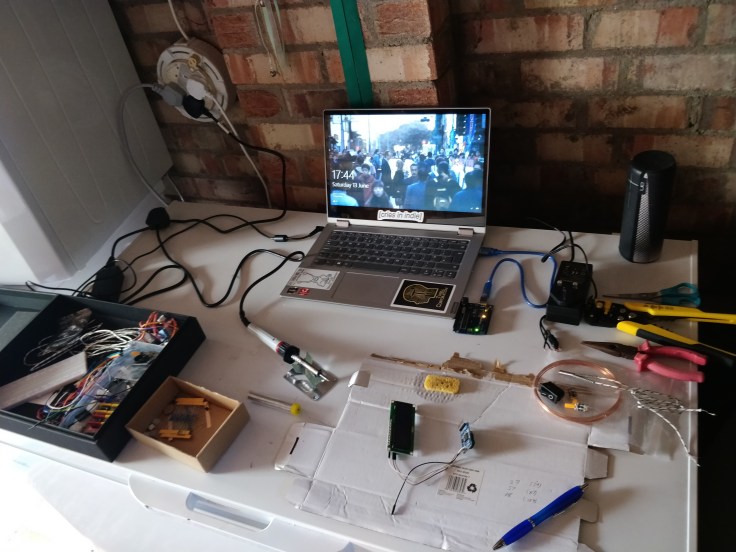
The garage is fairly large and well stocked with tools, I’ll set up camp on the top of the chest freezer, moving to the workmate when I need to clamp anything. The main inconvenience is the lack of working lights. I could certainly tackle this issue before beginning work but even when the lights did work, they were more “less-darks” than lights. The exposed rafters meant that rather than being reflected by a ceiling, most of their light loses its way amongst the clutter above; expired sports gear, a paddling pool put away “until next summer” and old tins of paint used to bring colour to a house that now only exists in childhood memories. At this stage these artefacts have all but accepted their state of disuse, becoming jaded with the prospect of being brought down and given new purpose, but if the lights come on they still sluggishly attempt to catch it in a flattering way so as to remind me of the good times. All of these knick-knacks of nostalgia trying to catch the light ensures that very little actually manages to light the room. So rather than fix the lights I’ll work by head-torch, that’s much more mad-scientisty anyway, I like that.
Forming the copper tubing into a spiralled plate isn’t as easy as I anticipated. The first thing I noticed is that the more I manipulate it with the pliers, the more scuffed and crooked the tubing becomes, I’d like to keep all that to a minimum since the relatively expensive copper was mainly chosen for aesthetics in the first place. Using my hands rather than pliers is time-consuming and not exactly comfortable but eventually I’ve ended up with something like the picture shows where the heater fits nicely into the middle protrusion.
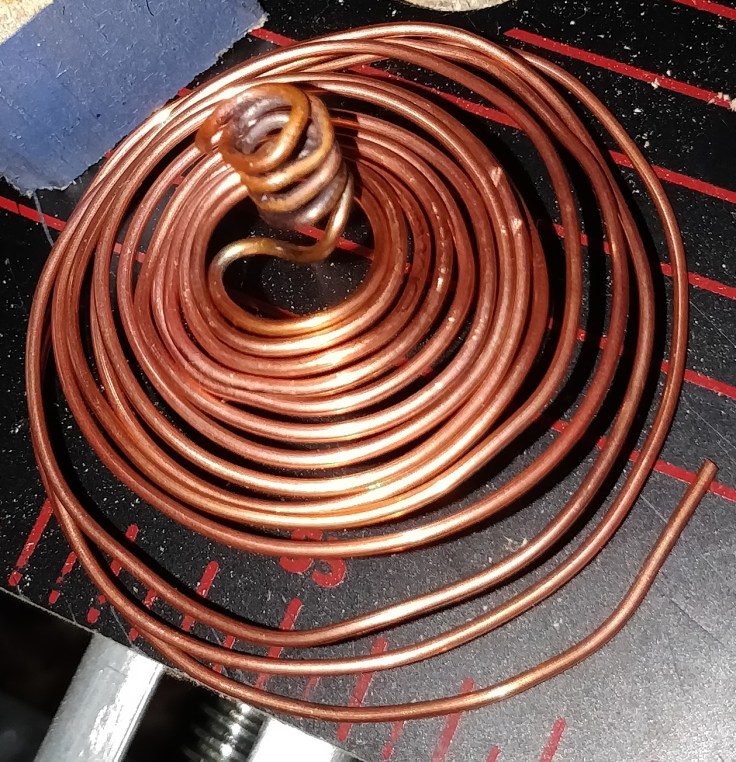
Ideally, that smaller coil that cradles the cartridge heater will wick the heat away very quickly and allow it to be transferred across the spiralled tubing which can in turn heat the bottom of a metal cup, which will then heat the water. There’s a pretty much constant draught in the garage so to avoid the air stealing heat away before it gets to the water I’ve made a sort of wooden enclosure for the whole thing – anything getting hot can either give its heat to the wood or to the metal cup. Hopefully, the metal cup is the more accepting of the two.
Test number 2 is now underway. Test number 2 has failed. Abort test number 2. Assess damage from test number 2.
 Trysworth Curiosity Company